Why the euro fell to a 17-month low against the dollar: France's budget and the OAT-Bund spread
EUR/USD touched $1.1161 in Asian trading on October 5, the weakest since May 2025, as the French-German 10-year spread widened again after France's 2027 budget.
- EUR/USD fell to $1.1161 at 03:07 UTC on October 5, 0.76% below Friday's close and the lowest since May 2025.
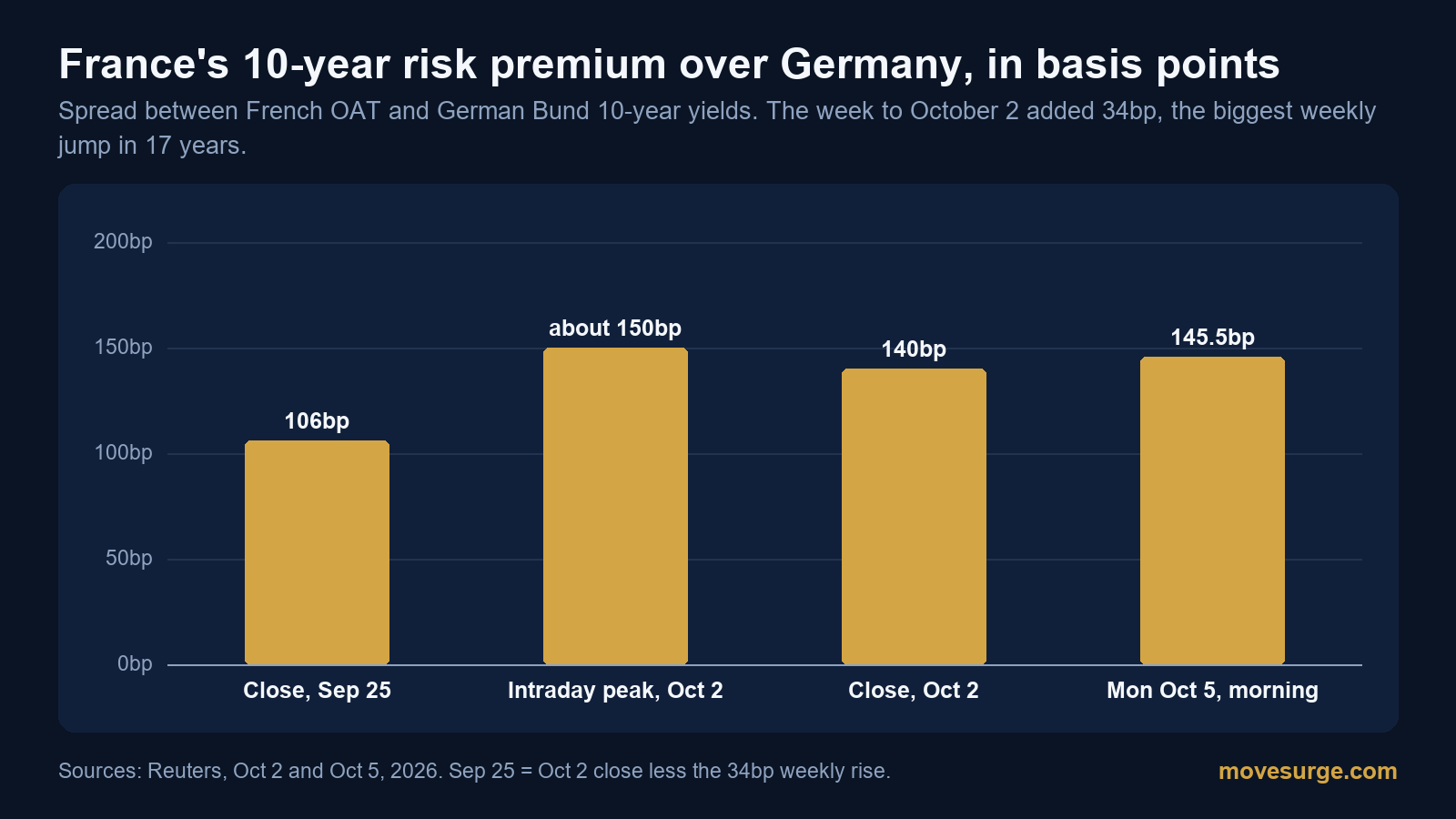
- The French-German 10-year spread widened to 145.5 basis points after a 34 basis-point jump in the week of the 2027 budget.
- The euro also fell 0.41% against sterling, its worst day against the pound since July 15.

The euro fell as low as $1.1161 against the dollar at 03:07 UTC on Monday, October 5 (11:07 p.m. ET on Sunday), its weakest level since May 2025 and 0.76% below Friday's close of $1.1246, according to MoveSurge's one-minute EUR/USD bars. The selling came from France's bond market, where the extra yield investors demand on French 10-year debt over German Bunds jumped 34 basis points in the week the 2027 budget was published and widened by another 5 basis points to 145.5 on Monday morning. By 09:53 UTC the euro had recovered to $1.1205, still 0.37% down on the day.
How the euro and French assets traded on Monday
| Market | Level | Move |
|---|---|---|
| EUR/USD, low at 03:07 UTC | $1.1161 | -0.76% from Friday's close; lowest since May 2025 |
| EUR/USD, 09:53 UTC | $1.1205 | -0.37% from Friday's close |
| EUR/GBP | 84.60 pence | -0.41%, the euro's biggest daily fall against sterling since July 15 |
| French 10-year yield | 4.9069% | up 4.1 basis points |
| OAT-Bund 10-year spread | 145.5 basis points | up 5 basis points; about 150 at Friday's peak, the widest since 2011 |
| CAC 40, early trading | 7,829.23 | -0.86% |
| Dollar index | 102.53 | highest since April 10, 2025 |
The euro's fall against sterling is what marks the move as a French problem. A drop against the dollar can simply reflect dollar strength, but EUR/GBP has no dollar in it, and the 0.41% decline there was the euro's worst day against the pound in nearly three months. US data was pulling the dollar the other way: after September payrolls rose by only 29,000 and unemployment reached 4.2%, traders priced a 78% chance that the Fed holds rates in October, up from 36% a week earlier.
What France's 2027 budget asks of bond investors
The budget presented on Thursday, October 1 targets a deficit of 5.0% of GDP in 2027, down from the 5.4% expected for 2026, through about €54 billion of savings, €43 billion of which are new measures such as capped pension indexation and a freeze on the public-sector pay index. Without those measures the deficit would run above 6.5% of GDP. Public debt still rises from about 119% of GDP to above 120% on a growth assumption of 1%, and France's fiscal watchdog, the High Council of Public Finances, called the forecast optimistic on the day it was published.
Prime Minister Sébastien Lecornu runs a minority government, parliament has 70 days to debate the bill, and the government needs it passed by mid-December. Pushing it through without a vote under Article 49.3 of the constitution would expose the government to a no-confidence motion, so bond investors are pricing a budget that may not survive in its current form.
Why a wider French spread pulls the euro down
The 10-year spread is the price of French fiscal and political risk inside the euro area. Investors who still want euro government bonds can switch from French paper to German Bunds without touching the currency, but foreign holders who leave French debt and want no other euro asset have to sell euros on the way out. French 10-year yields reached 4.96% on Friday, October 2, the highest since July 2002, and French five-year credit default swaps traded around 87 basis points, the highest since early 2013.
The spread also changes what the European Central Bank is likely to do. The ECB raised its deposit rate to 2.50% on September 10, its second increase of 2026, and higher euro-area rates have been one of the currency's supports this year. Speaking in Frankfurt on Monday, ECB chief economist Philip Lane described rising long-term rates as a material tightening of financial conditions and said weaker demand from higher energy costs can limit how far the ECB needs to adjust policy. Reuters reported the speech as a sign the energy shock may limit the need for further ECB action, which erodes part of the yield support the euro had been earning.
Why the low came at the Asian open
France made no new budget announcement over the weekend. The euro's low came in thin Asian trading before European markets opened, as Friday's widening in the spread carried into the new week, and the currency recovered part of the loss once European desks were trading. Parliament's debate on the bill, which the government needs finished by mid-December, is the next scheduled test for the spread.
Why was the euro falling on Oct 5, 2026?
The euro fell on Monday, October 5 because investors kept selling French government bonds after France's 2027 budget, widening the gap between French and German 10-year yields to 145.5 basis points. It also fell 0.41% against sterling, so the weakness was specific to the euro area.
How low did the euro fall against the dollar?
EUR/USD touched $1.1161 at 03:07 UTC on October 5, 2026, its lowest since May 2025 and 0.76% below Friday's close of $1.1246. It had recovered to $1.1205 by 09:53 UTC.
What is the OAT-Bund spread?
It is the difference between the yield on France's 10-year government bond, the OAT, and Germany's 10-year Bund. It rose 34 basis points in the week to October 2, its biggest weekly jump in 17 years, and peaked at about 150 basis points on Friday, the widest since 2011.
What is in France's 2027 budget?
It targets a deficit of 5.0% of GDP in 2027, down from 5.4% expected in 2026, through about €54 billion of savings. Public debt still rises above 120% of GDP, and France's fiscal watchdog called the growth forecast optimistic.
Sources
-
Euro sinks to 17-month low as French fiscal woes spur contagion fears
— Reuters via Investing.com
EUR/USD low of $1.1161, weakest since May 2025; OAT-Bund spread about 150bp on Friday, highest since 2011, and 145.5bp on Monday, up 5bp; dollar index 102.53
-
Euro sinks to 17-month low as French fiscal woes spur contagion fears
— The Standard (Reuters)
OAT-Bund spread ended last week at 140bp after a 34bp rise, the biggest weekly jump in 17 years
-
Chart of the day: EURUSD at lowest since May 2025 amid French fiscal crisis
— XTB
EUR/USD low of 1.1161; traders price a 78% chance of an October Fed hold, up from 36% a week earlier
-
Sterling on track for biggest daily rise vs euro in months
— Global Banking & Finance Review (Reuters)
Euro down 0.41% at 84.60 pence, its biggest daily fall against sterling since July 15
-
L'Europe ouvre dans le désordre, les craintes budgétaires pénalisent le CAC 40
— Boursorama (Reuters)
French 10-year yield at 4.9069%, up 4.1bp; CAC 40 down 0.86% at 7,829.23 in early trading
-
France's 2027 budget targets 5% deficit; watchdog calls forecast optimistic
— EU Insider
2027 deficit target of 5.0% of GDP versus 5.4% in 2026; about €54bn of savings including €43bn of new measures; deficit above 6.5% without them; debt from about 119% to above 120% of GDP; 1% growth assumption; HCFP called it optimistic
-
Explainer: How France's 2027 budget battle could play out
— Reuters via Internazionale
Minority government; parliament has 70 days to debate; passage needed by mid-December; Article 49.3 would invite a no-confidence motion
-
France's 10-year yield hits highest since 2002
— FXStreet
French 10-year yield reached 4.96% on October 2, the highest since July 2002
-
Five French market hot spots
— Reuters via AOL
French five-year CDS around 87bp, the highest since early 2013
-
Diagnostic challenges for ECB monetary policy
— European Central Bank
Lane: rising long-term rates are a material tightening of financial conditions; demand-destruction channels can limit the required adjustment in the monetary stance
-
ECB's Lane: recent energy price surge a drag on growth, may limit need for ECB action
— Reuters via Investing.com
Lane said high energy costs, lower budget support and higher borrowing costs weigh on demand
-
The euro sells off hard as the French-German bond gap widens
— TMGM
ECB deposit rate raised to 2.50% on September 10, the second hike of 2026
-
The Employment Situation, September 2026
— U.S. Bureau of Labor Statistics
Payrolls rose 29,000 in September; unemployment rate 4.2%
Never miss the next market-moving story
Follow the core market-moving feed across equities, macro, currencies and commodities. Your subscription includes recorded price reactions, search, watchlists, alerts and research tools.
Create free accountGo real time Watch live headlines -- free