Fed minutes for September 2026: a unanimous hike, another likely by year end, and the yen intervention on the record
Every participant backed the quarter-point increase to 3.75% to 4.00%, most expected another by the end of 2026, and the New York Fed disclosed it intervened for the Treasury to support the yen in July.
- All participants at the September 15-16, 2026 meeting supported raising the federal funds range to 3.75% to 4.00%; most judged another increase likely appropriate by year end.
- The New York Fed intervened in the currency market for the Treasury, with Treasury funds, during the joint US-Japan yen operation of July 31.
- Officials split on the reason: some cited energy and price shocks, a more hawkish group cited demand pressure from AI-related construction.

Reaction by asset (real prices)
| Asset | 2m before | At release | +1m | +10m | +1m % | +10m % |
|---|---|---|---|---|---|---|
| US100 | 31356.00 | 31356.00 | 31348.75 | 31381.00 | -0.02% | +0.08% |
Minutes of the Federal Reserve's September 15–16, 2026 meeting, released at 2:00 pm ET on Wednesday, October 7, show that every participant supported raising the federal funds target range by a quarter point to 3.75% to 4.00%, and that most of them judged another increase would likely be appropriate by the end of the year. The minutes give no indication of when. They also disclose that the New York Fed's trading desk, acting as fiscal agent for the US Treasury and using Treasury money, intervened in the currency market during the joint US–Japan operation to support the yen in late July.
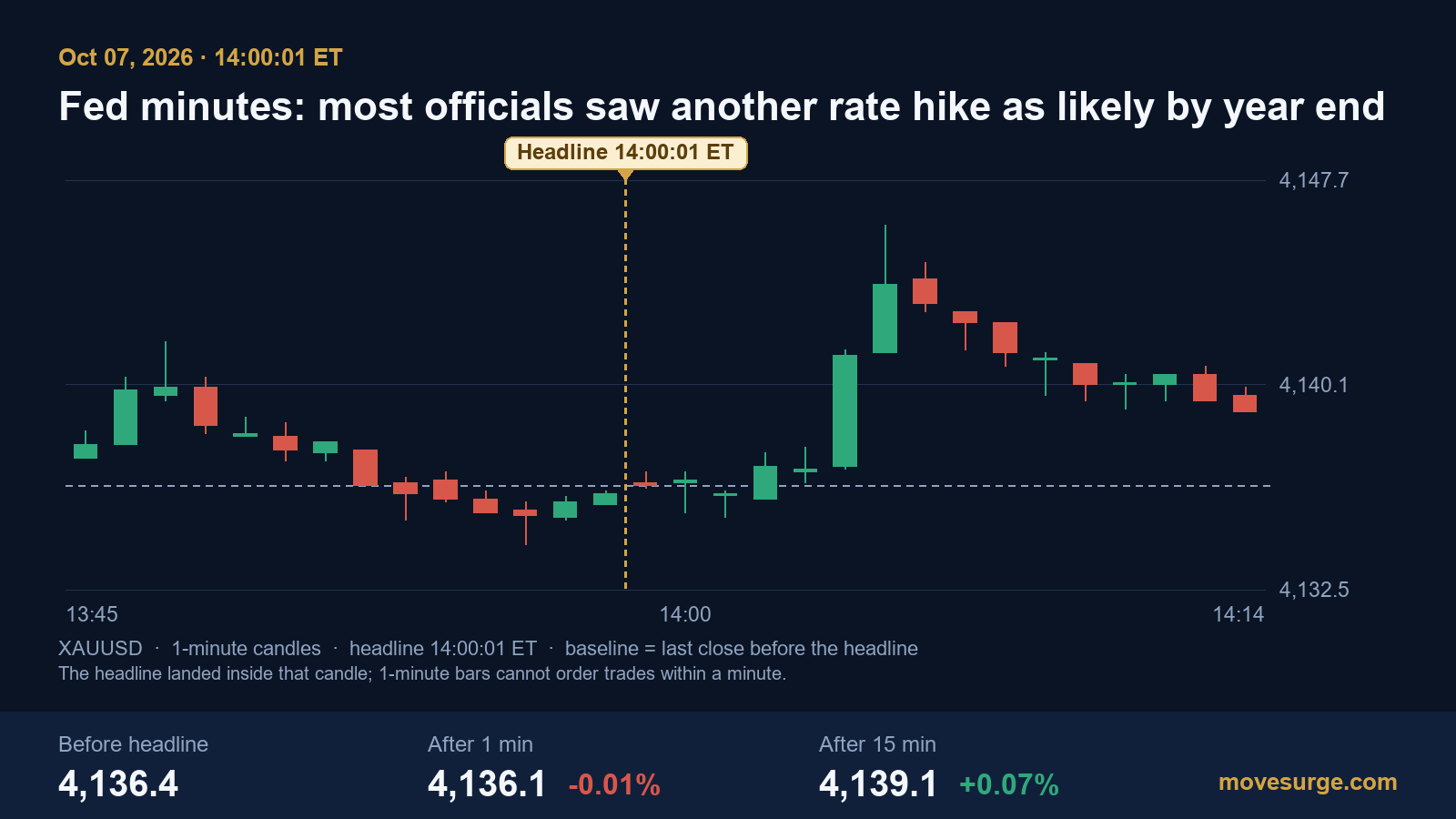
Prices barely moved. The first headline from the minutes reached the MoveSurge news feed at 14:00:01 ET, and the Nasdaq 100 contract we track was 0.02% lower a minute later and 0.06% higher fifteen minutes later, at 31,375.25 against 31,356.0 before the release; our reaction reading for a later minutes headline at 14:00:36 ET had it 0.08% higher after ten minutes. Gold rose 0.07% over the same fifteen minutes, from $4,136.40 to $4,139.10. After the release, rate futures priced no change at the October 27–28 meeting and an increase in December, CNBC reported, which is close to the path the minutes describe.
What the September minutes said
| Topic | What the minutes record |
|---|---|
| Decision | Target range raised 25 basis points to 3.75% to 4.00%, the first increase since July 2023; the vote was 12 to 0 and all participants supported it |
| Next step | Most participants judged another increase would likely be appropriate by year end; no timing given |
| Inflation risk | Almost all participants saw the risks tilted to the upside |
| Policy stance | Several participants viewed the current rate as not restrictive or only mildly restrictive |
| AI investment | Several participants said the scale and pace of AI-related construction kept exceeding expectations |
| Staff forecast | Inflation projected somewhat higher for 2026 through 2028 than in July, with a stronger outlook for activity and jobs |
| Currency operations | The desk intervened in the currency market for the Treasury with Treasury funds; the Fed's own portfolio was not involved |
Why officials raised rates for different reasons
The vote was unanimous, but Reuters' reading of the minutes found two rationales behind it. Some participants treated the September increase as insurance against the energy and price shocks of recent months feeding into broader inflation. A more hawkish group saw it as a response to inflation driven by demand, with several officials warning that the AI construction boom could push spending ahead of the economy's capacity to supply it. A hike meant to contain an energy shock can end once oil prices settle, while one aimed at excess demand has to run as long as the investment boom does, so the two camps could agree on September and still differ on December.
The minutes also show that several officials did not consider policy tight even at 3.75% to 4.00%, a view that leaves room for the further increase most participants expected by year end.
The yen intervention, now on the record
The United States and Japan intervened together to support the yen on Friday, July 31, 2026, and Treasury Secretary Scott Bessent and Japan's finance minister, Satsuki Katayama, confirmed the joint operation on August 3. The minutes set out the Fed's part in it: the New York Fed acted purely as the Treasury's agent, the money came from the Treasury, and the System Open Market Account, the Fed's own securities and currency portfolio, was not used, so the yen sits on the Treasury's books and has no effect on the Fed's balance sheet. The minutes do not state the size of the operation. It was the first US currency intervention since the coordinated G7 action of March 2011.
The bond market the same day
The minutes landed an hour after the Treasury sold $39 billion of new 10-year notes. Earlier in the day the 10-year yield touched 5.35%, its highest since 2002, and the auction cleared at a high yield of 5.30%, the highest at a 10-year sale since 2000. Demand was strong: bidders offered 2.77 times the amount on sale against a twelve-month average of 2.51, and indirect bidders, the category that includes foreign central banks, took 80.3%. The 10-year yield eased to about 5.288% after the result, CNBC reported, so the auction had already removed one source of pressure before the minutes arrived. Our earlier page covers why the 10-year yield reached 5.35%.
Timeline
- July 31, 2026: the United States and Japan intervene to support the yen; the New York Fed acts for the Treasury.
- September 16, 2026: the Fed raises the target range to 3.75% to 4.00%, its first increase since July 2023.
- October 7, 2026, 1:00 pm ET: the 10-year note auction clears at 5.30%.
- October 7, 2026, 2:00 pm ET: the minutes of the September meeting are released.
- October 27–28, 2026: the next policy meeting.
What did the Fed minutes say on October 7, 2026?
The minutes of the September 15-16 meeting show every participant supported the quarter-point increase to 3.75% to 4.00%, and most judged another increase would likely be appropriate by year end. Almost all participants saw inflation risks tilted to the upside.
Will the Fed raise rates again in 2026?
Most officials expected another increase by year end, according to the minutes, but they gave no timing. After the release, rate futures priced no change at the October 27-28 meeting and an increase in December, CNBC reported.
Did the Fed intervene to support the yen?
The New York Fed intervened in the currency market as the Treasury's agent, using Treasury funds, during the joint US-Japan action of July 31, 2026. The Fed's own portfolio was not involved, and the minutes do not give the size.
How did markets react to the Fed minutes?
Barely. The Nasdaq 100 contract we track was 0.06% higher fifteen minutes after the first headline at 14:00:01 ET, and gold was up 0.07%.
Sources
-
Minutes of the Federal Open Market Committee, September 15-16, 2026
— Federal Reserve Board
All participants supported raising the target range to 3-3/4 to 4 percent; most assessed another increase would likely be appropriate by year end; the Desk intervened in the currency market as fiscal agent for the Treasury using Treasury funds, with the System Open Market Account not involved; staff outlook stronger than in July.
-
Fed officials see another hike coming, but no sign as to when, minutes show
— CNBC
Officials expected another hike but the minutes gave no indication of when; futures priced no move in October and a hike in December.
-
Fed policymakers divided over rate-hike logic in September, minutes show
— Reuters via Investing.com
The vote was unanimous; some participants saw the hike as a guard against energy and price shocks spreading, a more hawkish group as a guard against demand-driven inflation; next meeting October 27-28.
-
Fed Used Treasury Funds to Support Yen in Joint Intervention
— Bloomberg
The minutes show the New York Fed used Treasury funds when it intervened to support the yen alongside Japan.
-
Fed officials feared inflation pressures could spread, minutes show
— Axios
Several participants viewed the policy rate as not restrictive or only mildly restrictive.
-
Breaking: Fed Minutes confirm another rate hike was already in sight
— FXStreet
Almost all participants saw inflation risks tilted to the upside; several said AI-related construction exceeded expectations.
-
10-year Treasury yield backs off from 24-year high after solid bond auction eases demand fears
— CNBC
The 10-year yield hit 5.35%, the highest since 2002; the $39 billion 10-year auction cleared at a 5.300% high yield, the highest since 2000, with a 2.77 bid-to-cover against a 2.51 average and 80.3% indirect take; the yield eased to about 5.288% afterward.
-
Federal Reserve issues FOMC statement
— Federal Reserve Board
The Committee raised the target range for the federal funds rate by 25 basis points on September 16, 2026.
-
Fed finally hikes, dot plot sees more rate hikes, new rate-hike cycle starts
— Wolf Street
The September 2026 increase was the Fed's first rate hike since July 2023.
-
US and Japan confirm yen intervention
— CNBC
The US and Japan intervened to support the yen on Friday, July 31, 2026; Bessent and Katayama confirmed the coordinated action; it was the first US intervention since 2011.
Never miss the next market-moving story
Follow the core market-moving feed across equities, macro, currencies and commodities. Your subscription includes recorded price reactions, search, watchlists, alerts and research tools.
Create free accountGo real time Watch live headlines -- free