Nvidia lost 16.9% on Monday, January 27, 2025. About $589 billion of market value vanished in one day.
DeepSeek had released its R1 model seven days earlier. Developers noticed first. Most investors did not.
By Sunday, DeepSeek was the No. 1 free app in the United States. Posts about a “$6 million model” were reaching millions of people.
The market opened on Monday with one simple fear: cheap AI could cut demand for expensive chips. DeepSeek’s paper made a narrower claim.
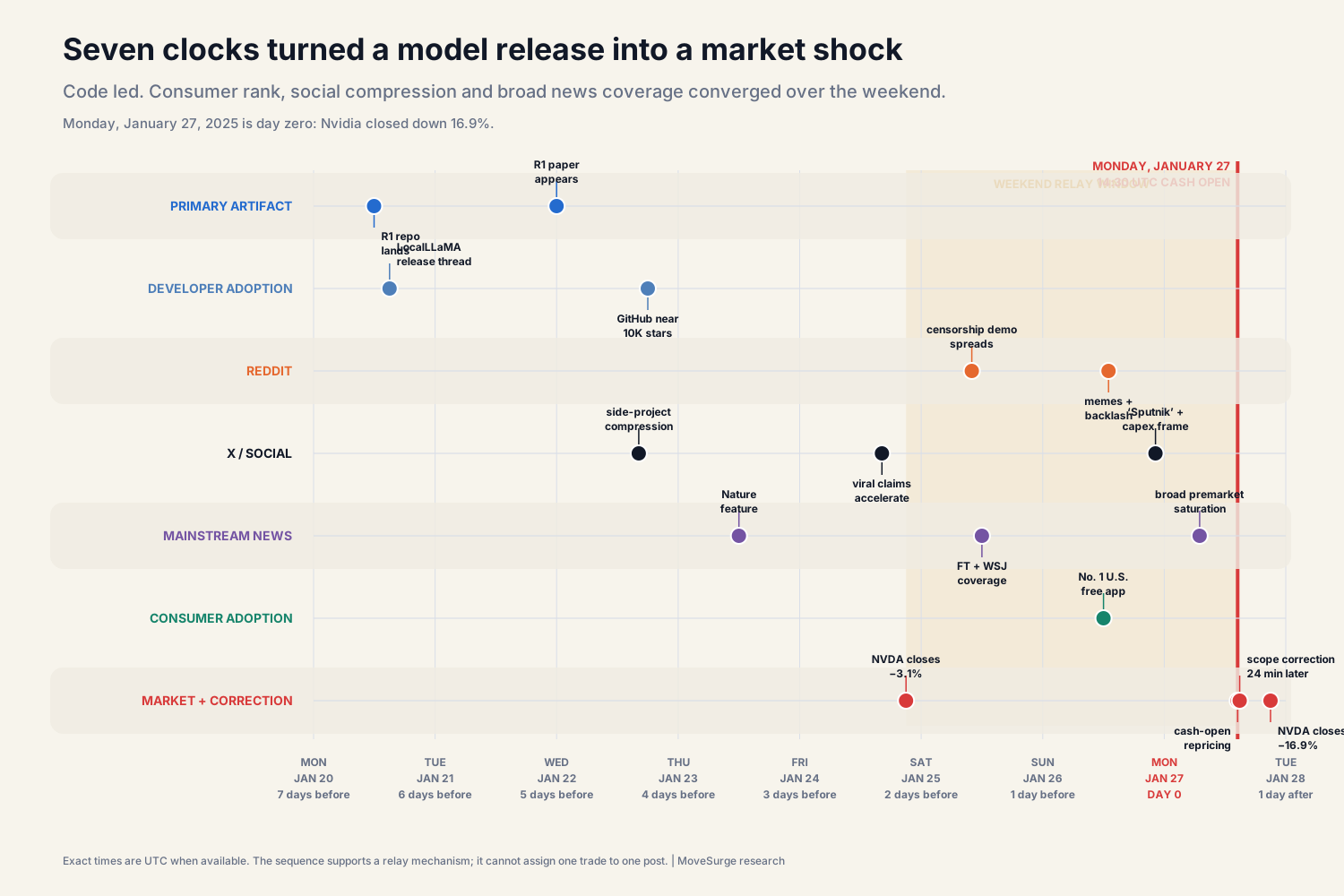
Monday: The First Signal in Code
DeepSeek released R1 on Monday, January 20—seven calendar days before Nvidia’s historic drop.
The first serious audience lived in developer communities. A LocalLLaMA thread covered distillation, local deployment, licensing, quantization and benchmark limits. Its contemporaneous snapshot passed 1,000 upvotes and 360 replies within five days.
GitHub supplied a stronger speed signal. Public event analysis shows more than 2,000 stars on release day, close to 10,000 by Wednesday and close to 20,000 by Sunday. Those are thresholds and ranges. The raw daily star export is unavailable.
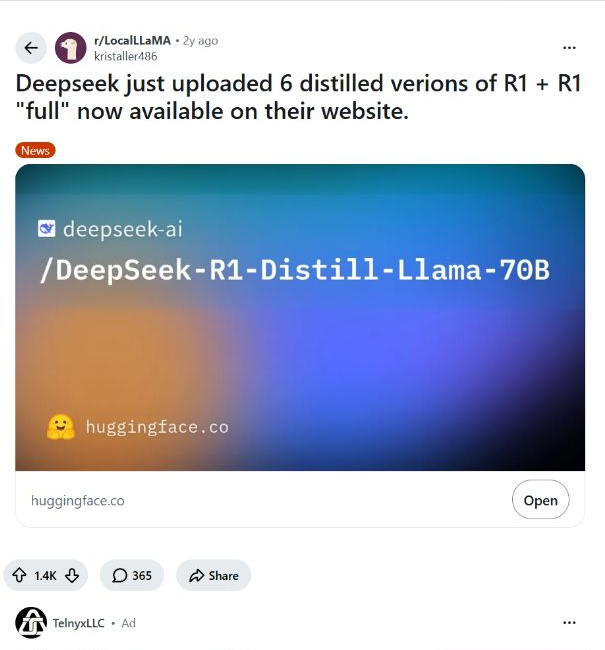
Current public snapshot: 1,350 score and 365 comments. The discussion focused on practical model use and technical limits.
https://www.reddit.com/r/LocalLLaMA/comments/1i5or1y/deepseek_just_uploaded_6_distilled_verions_of_r1/Wednesday: A Frontier Model in One Line
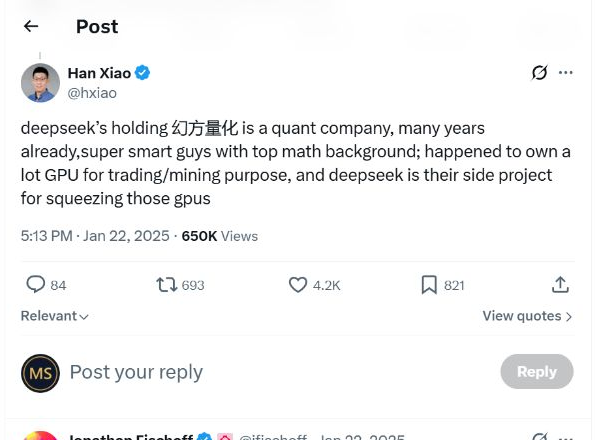
On Wednesday, January 22—five days before the drop—Han Xiao described the work as a side project by two PhDs. The line was easy to remember. It erased the longer research program behind V3 and R1.
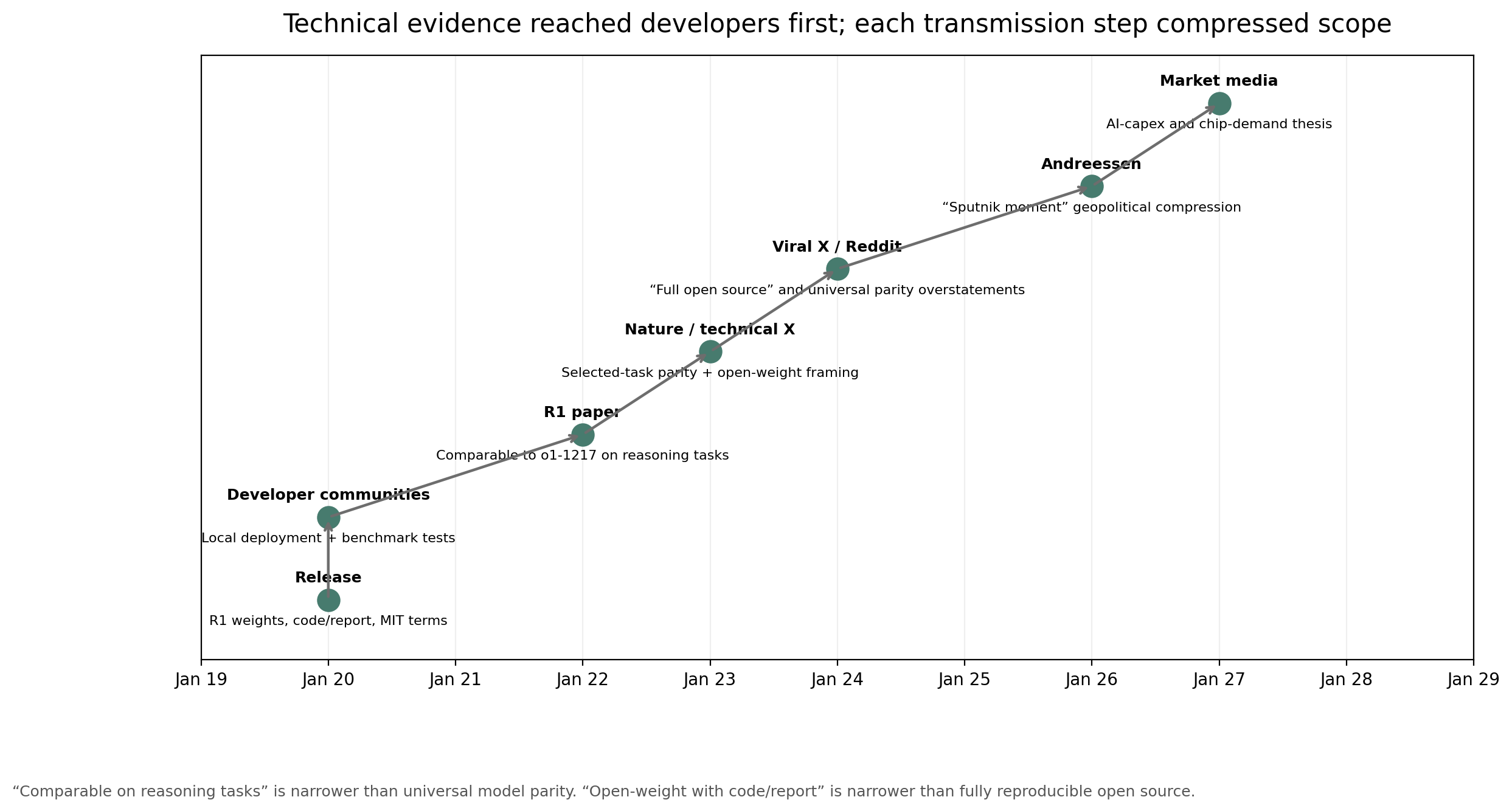
On Thursday, January 23—four days before the drop—Artificial Analysis framed DeepSeek as 25 times cheaper while offering similar reasoning performance. That comparison covered a specific inference-pricing context. Reposts soon treated it as proof of total training economics.
Nature also published a detailed feature on Thursday. Traditional media had already found DeepSeek. Broad, multi-outlet market coverage arrived later.
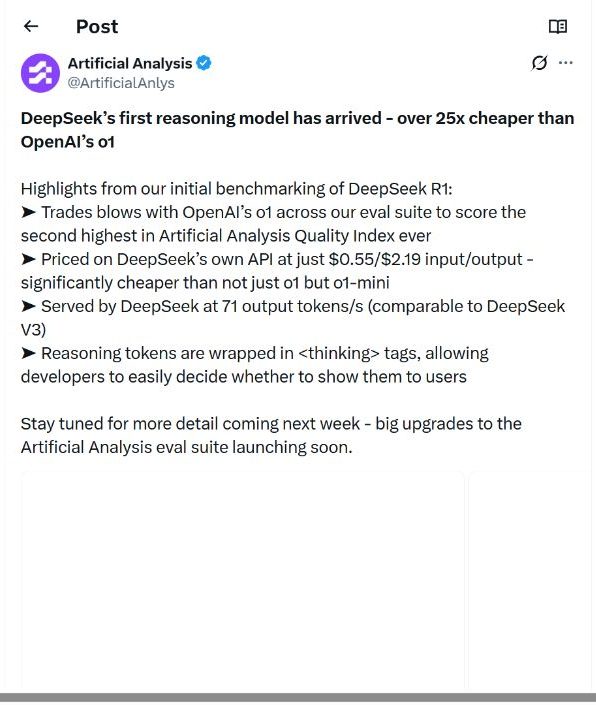
Useful inside its inference-pricing scope. Misleading when repeated as an all-in training-cost claim.
https://x.com/ArtificialAnlys/status/1882454212556259369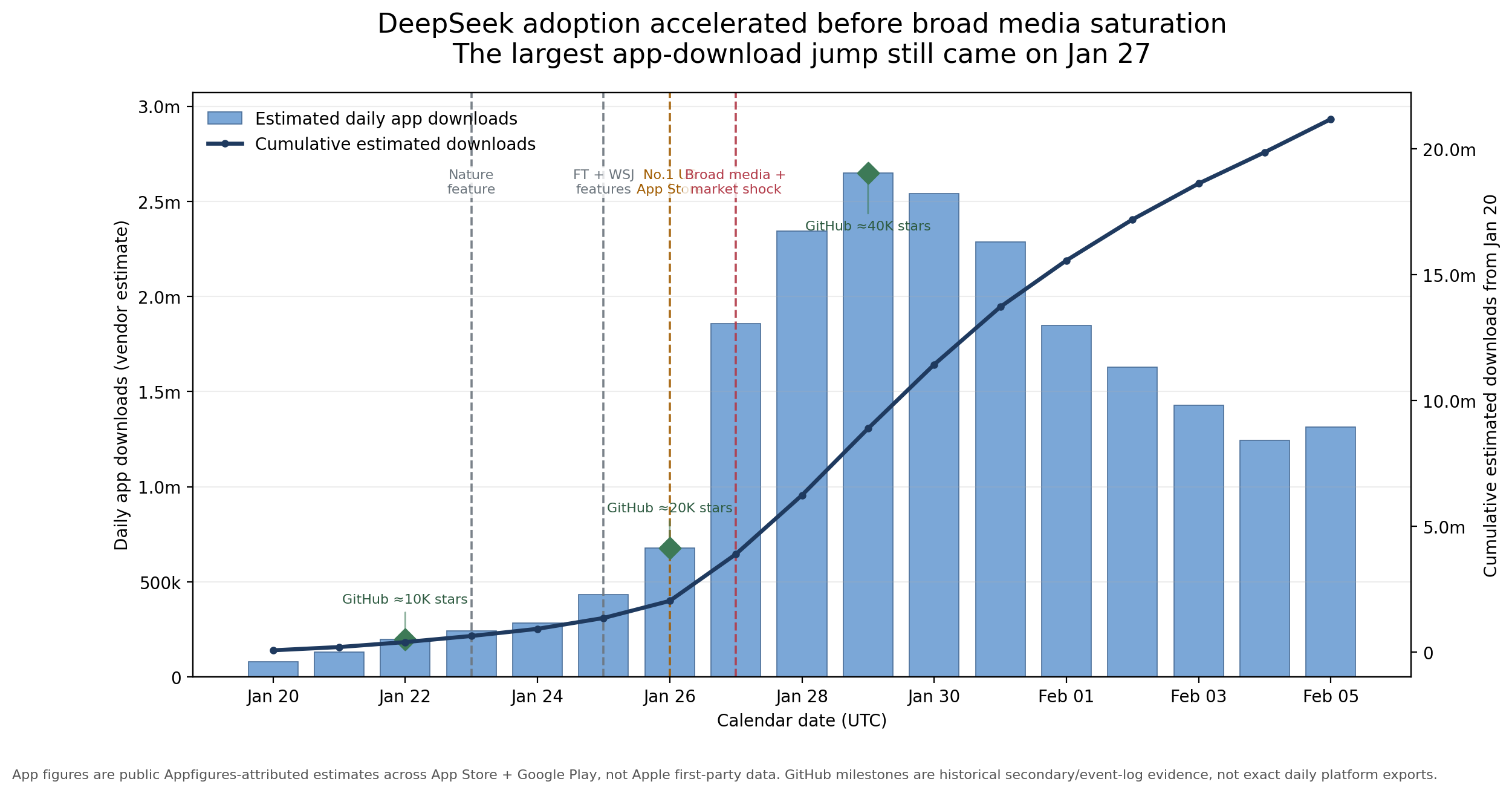
Developer adoption led broad news saturation. The app’s largest estimated daily download jump came on Monday, after the news and market shock were already underway.
Friday: Attention, Cost and Market Risk
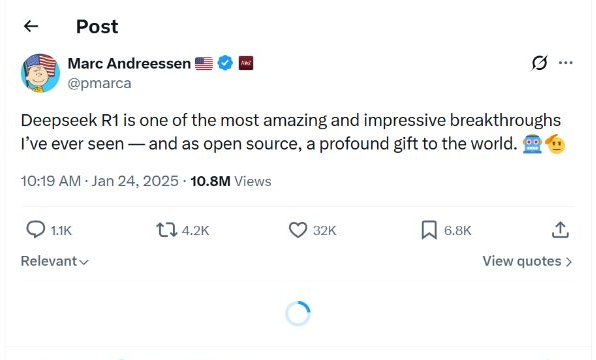
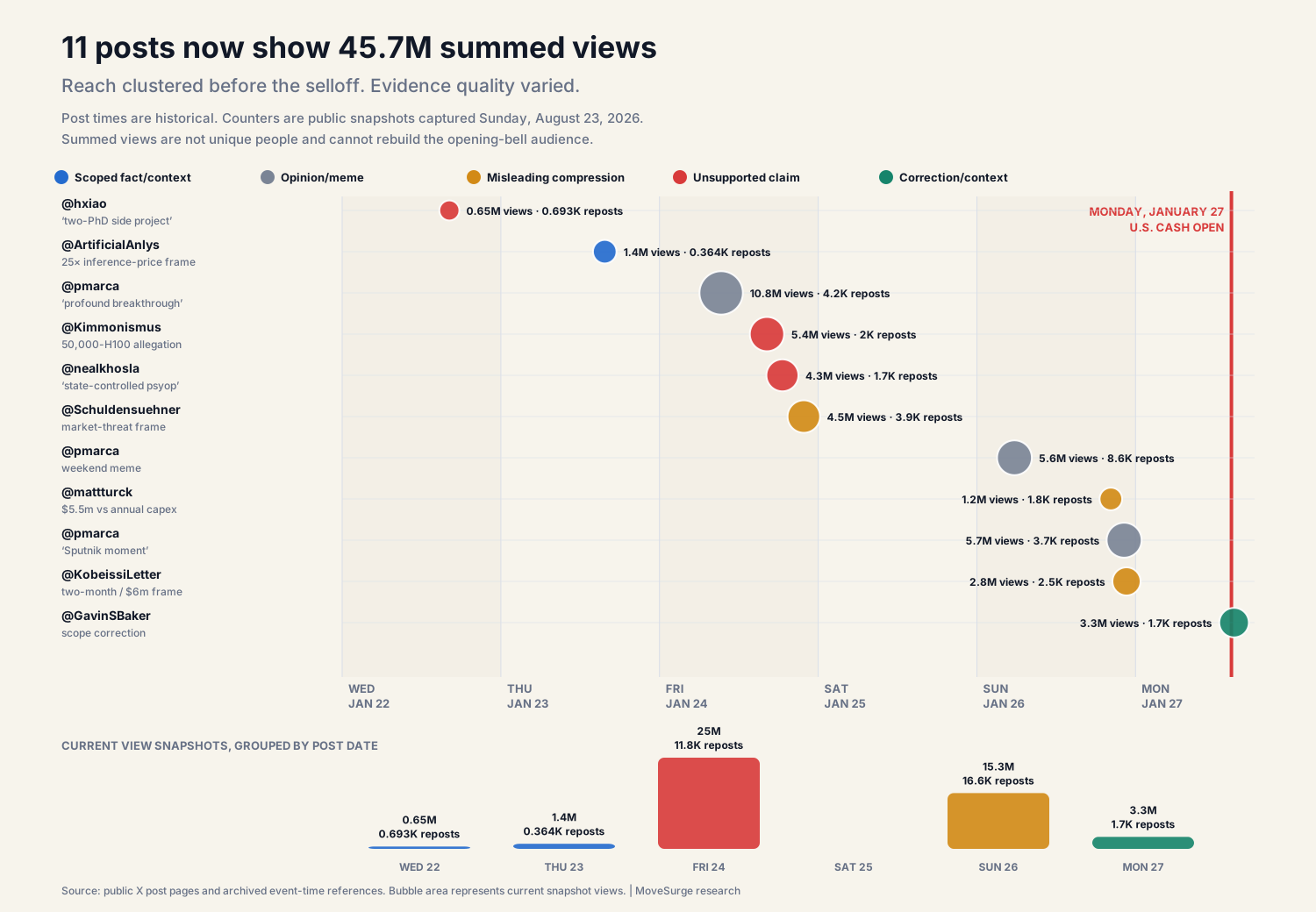
Marc Andreessen called R1 a profound breakthrough. His post now shows 10.8 million views.
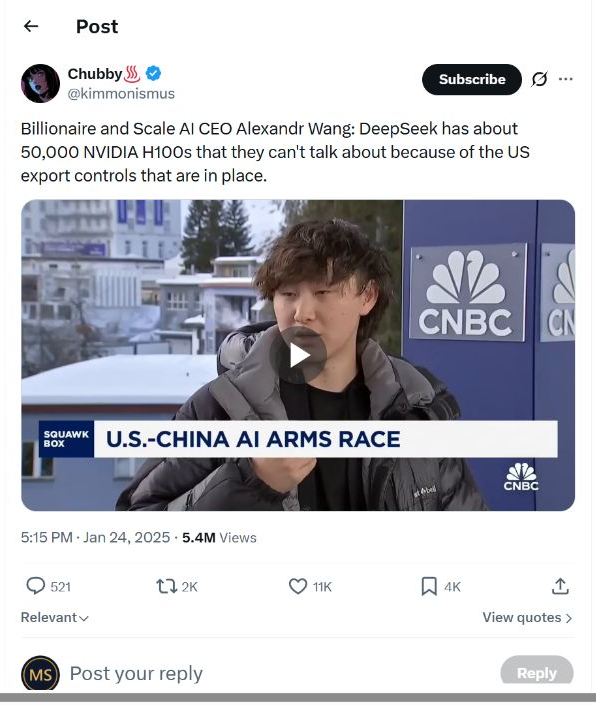
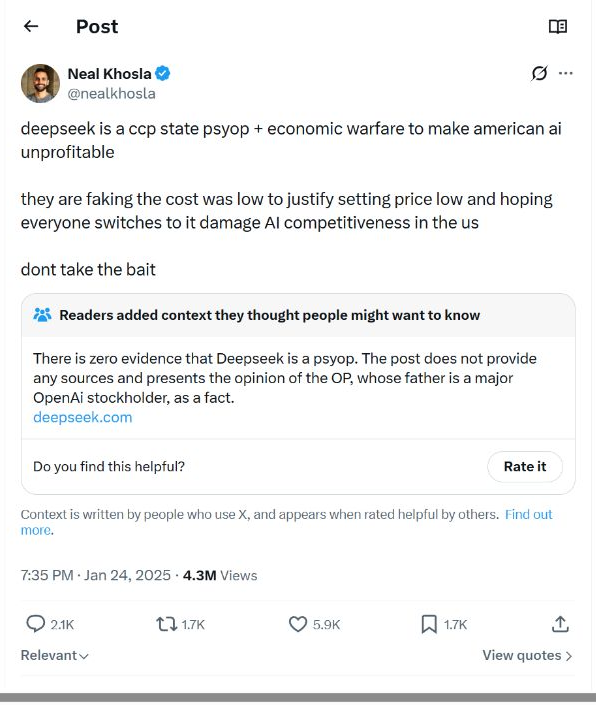
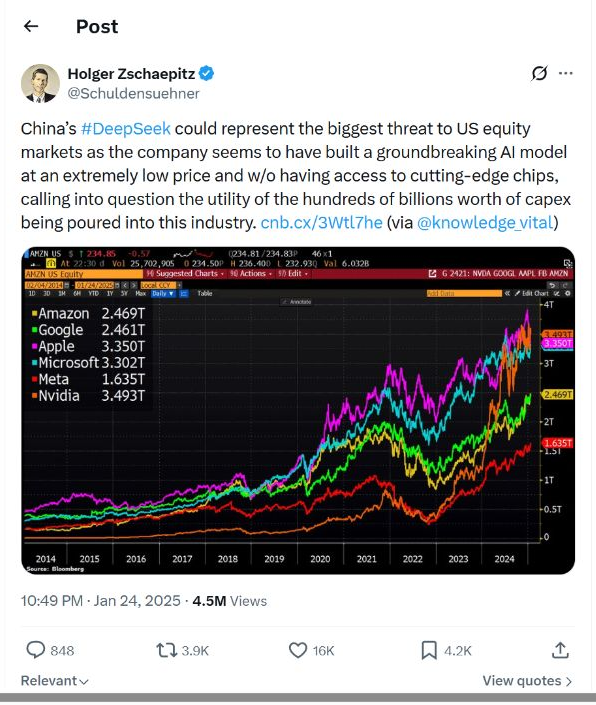
Three stronger claims followed. One account alleged that DeepSeek controlled about 50,000 H100 chips. Neal Khosla called the company a state-controlled psychological operation. Holger Zschaepitz framed DeepSeek as a major threat to U.S. equities.
The chip count and psychological-operation claims lacked public evidence. A Community Note challenged Khosla’s post. The market-threat claim was opinion built on uncertain cost and hardware assumptions.
These four posts now show more than 25 million summed views. Current counters measure cumulative reach. They do not tell us how many views existed before Monday’s opening bell.
Reddit: Trust, Privacy and Politics
A Saturday r/ChatGPT post showed the hosted chatbot refusing a political prompt in real time. Its contemporaneous snapshot passed 9,800 upvotes and 700 comments within two days.
The debate now covered censorship, privacy and China alongside cost and model quality. Each theme pulled a different audience into the same story.
The Financial Times and The Wall Street Journal published substantive reporting by Saturday. The evidence supports an early specialist-media phase, followed by broad market saturation on Monday.
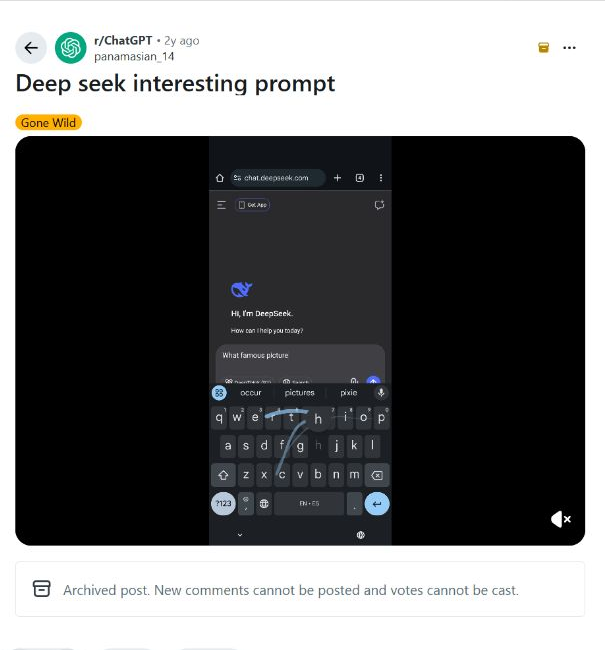
Historical lower bound: more than 9,800 upvotes and 700 comments within two days. Current snapshot: 11,497 score and 769 comments.
https://www.reddit.com/r/ChatGPT/comments/1i9zjgk/deep_seek_interesting_prompt/Sunday: App-Store Dominance and Narrative Certainty
DeepSeek reached No. 1 in the U.S. free-app chart. A developer story became a consumer story.
Marc Andreessen called it AI’s “Sputnik moment.” Matt Turck compared $80 billion and $65 billion corporate spending plans with DeepSeek’s $5.5 million figure. The Kobeissi Letter described a model built in under two months for under $10 million with old chips and fewer than 200 people.
The Kobeissi post mixed true facts with misleading comparisons. The App Store rank was true. “Under two months” covered V3 pre-training. The H800s were export-limited AI chips, not old consumer chips. The team claim did not count years of earlier work and computer systems.
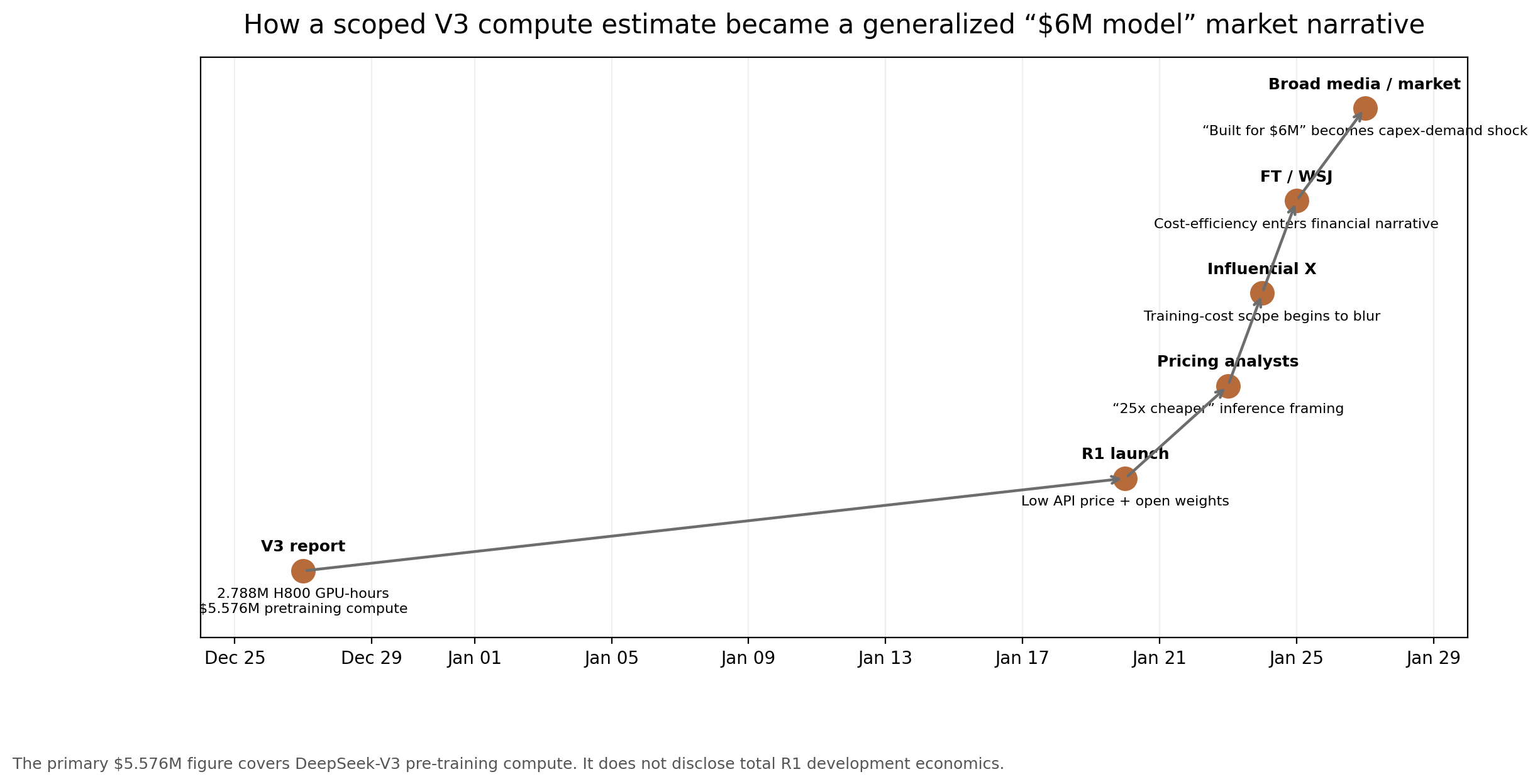
DeepSeek’s $5.576 million figure covered the official V3 training work at an assumed compute price. It excluded earlier research, experiments and broader infrastructure.
Reuters later reported that High-Flyer built a cluster with 1,100 A100 chips in 2020 and another with about 10,000 A100 chips in 2021. DeepSeek did not start from zero with a $5.576 million budget.
Stargate’s $500 billion figure was a private plan for four years of AI infrastructure, with $100 billion planned first. It was not a U.S. government payment or the cost of one model.
By Sunday, the same short claim appeared in viral posts, app rankings and news reports.
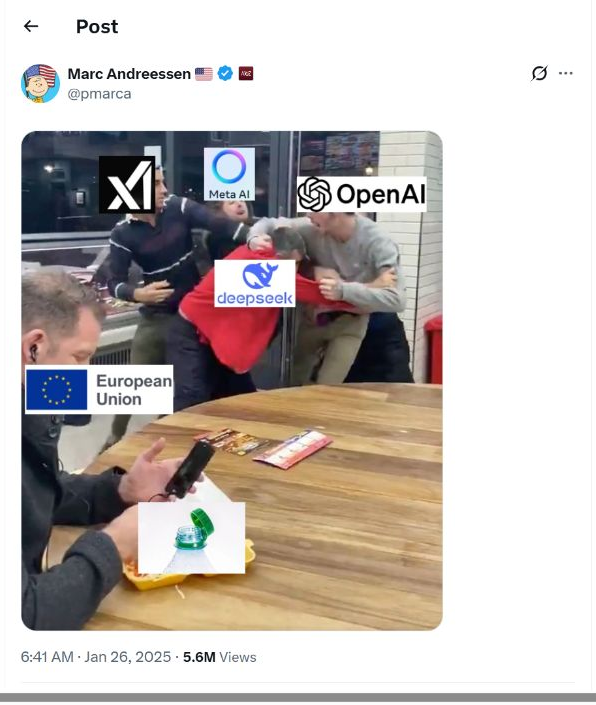
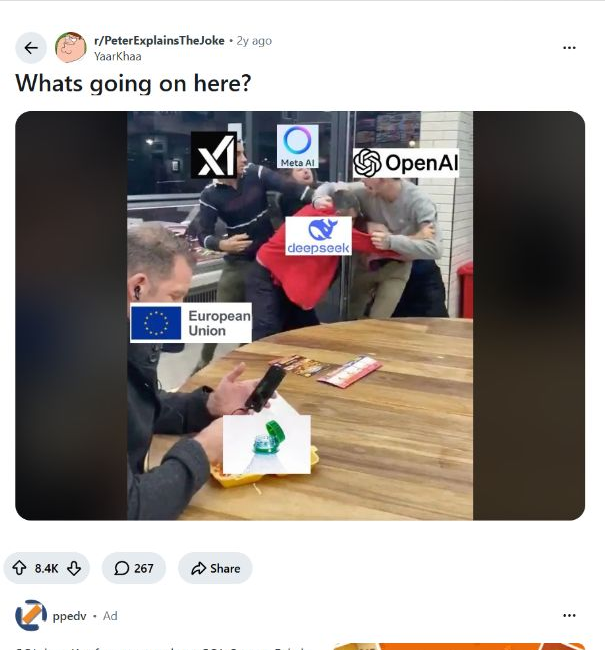
Historical lower bound: more than 7,000 upvotes within one day.
https://www.reddit.com/r/PeterExplainsTheJoke/comments/1iak5jq/whats_going_on_here/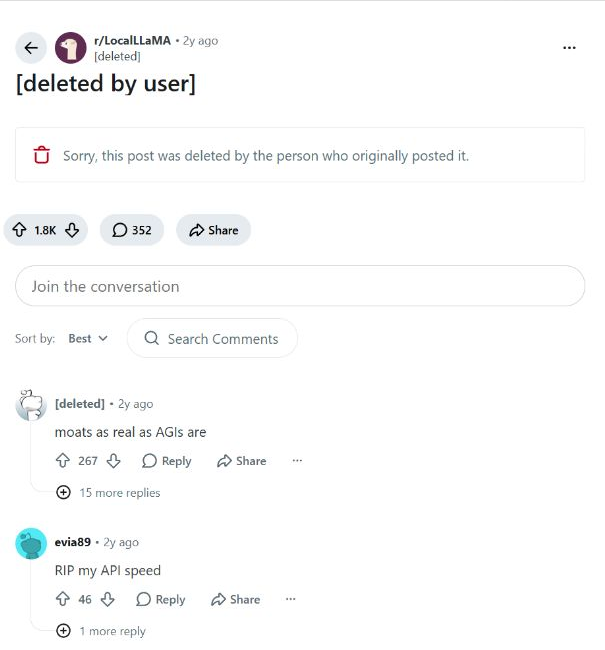
The current Reddit page is deleted. The No. 1 U.S. free-app rank is confirmed by independent coverage.
https://www.reddit.com/r/LocalLLaMA/comments/1iasyc3/deepseek_is_1_on_the_us_app_store/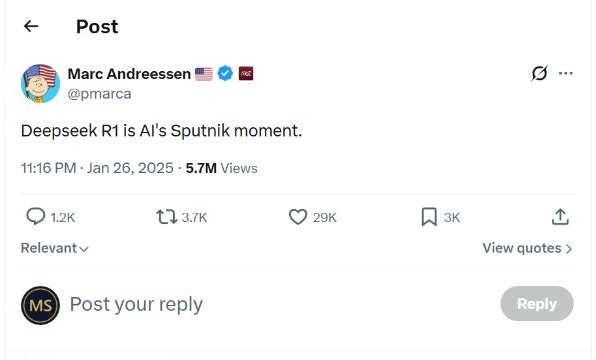
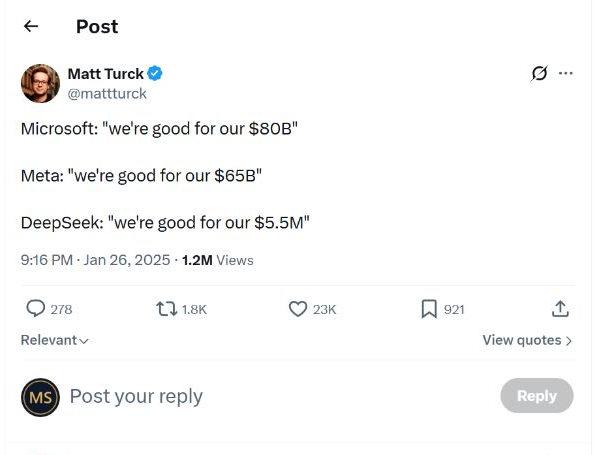
Annual infrastructure plans were compared with a bounded V3 training-compute estimate.
https://x.com/mattturck/status/1883609972602548406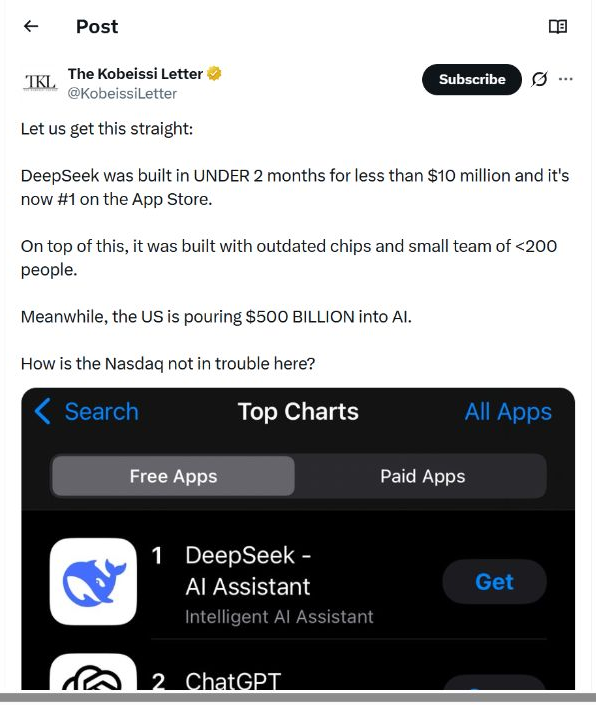
Top of the post: App Store rank, team and hardware claims.
https://x.com/KobeissiLetter/status/1883645592569593881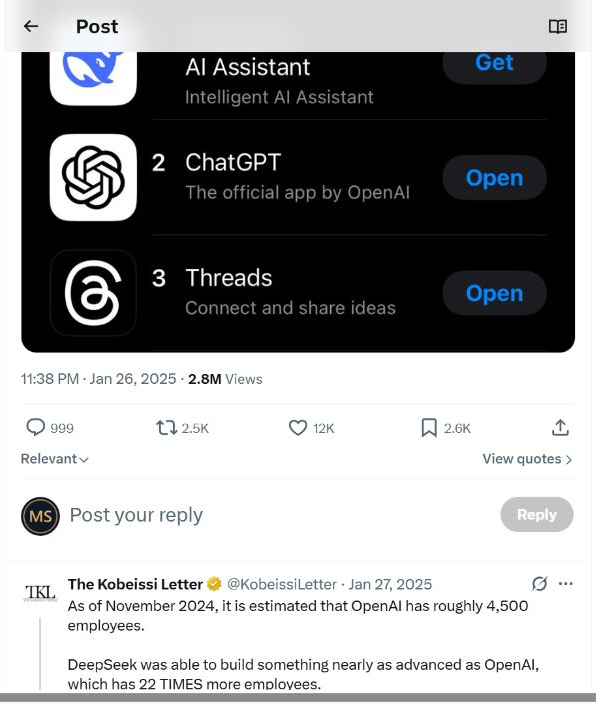
Monday: The Opening Bell and the Shortest Story
By Monday morning, news reports said cheaper AI could mean less demand for expensive chips. CNBC wrote that a model had been developed in two months for under $6 million. The V3 paper did not make that claim.
Nvidia fell 16.9% from Friday’s close. Its share volume reached 3.85 times the prior five-session average. The Nasdaq lost 3.1%, while the Dow rose 0.7%. The damage centered on the AI infrastructure trade.
Across common five-minute regular-session bars, Nvidia and the US100 proxy had a 0.575 return correlation. A pre-event beta model estimated about −12.5% abnormal return for Nvidia. The stock underperformed its technology-market relationship by a wide margin.
The chart shows when each event happened and how large the move was. It cannot divide the move among posts, television, analyst notes, crowded positions and automated risk controls.
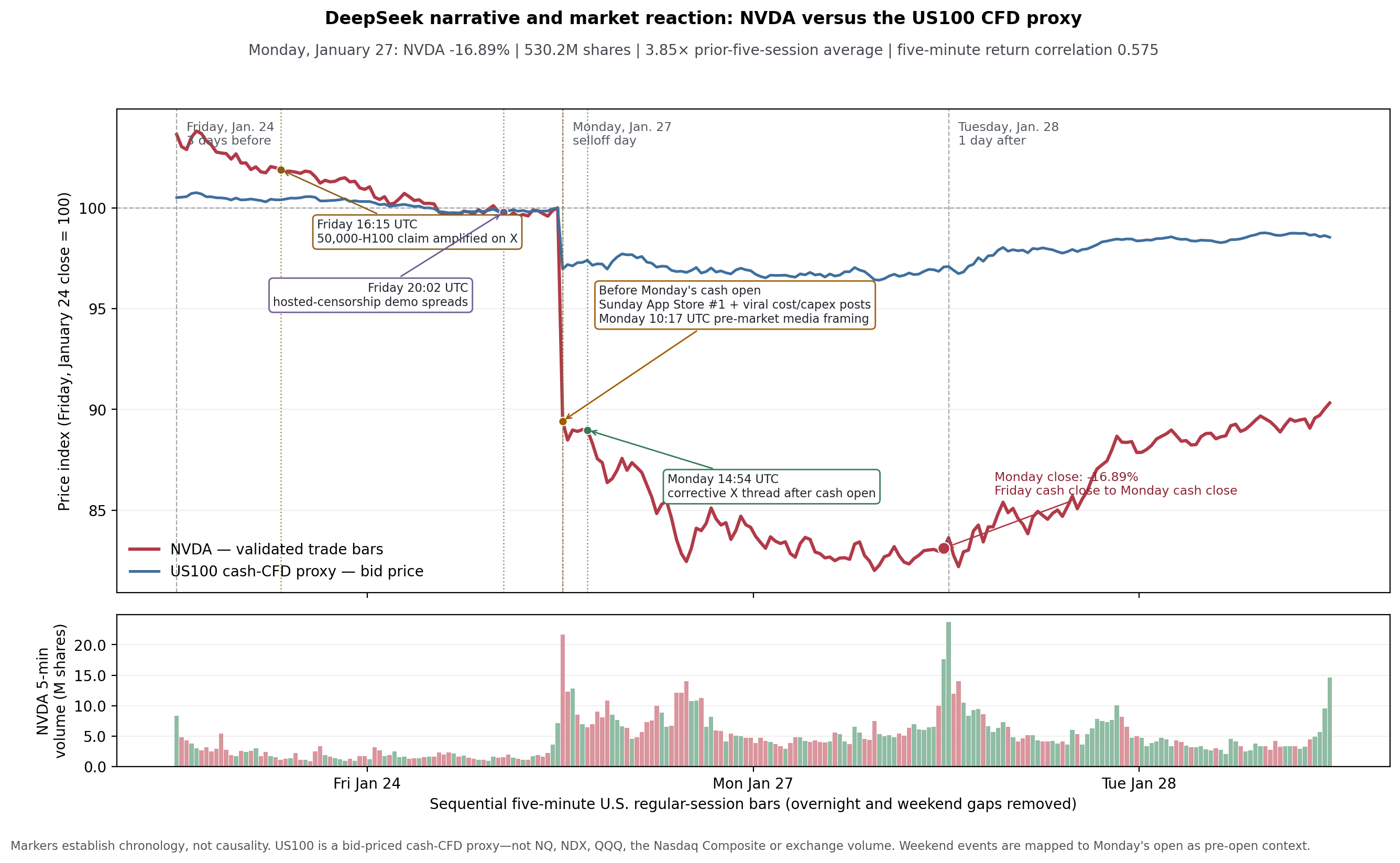
Both price lines start at 100. Arrows mark the news and social events. The lower panel uses Nvidia share volume only.
Monday Afternoon: Corrections After the Selloff
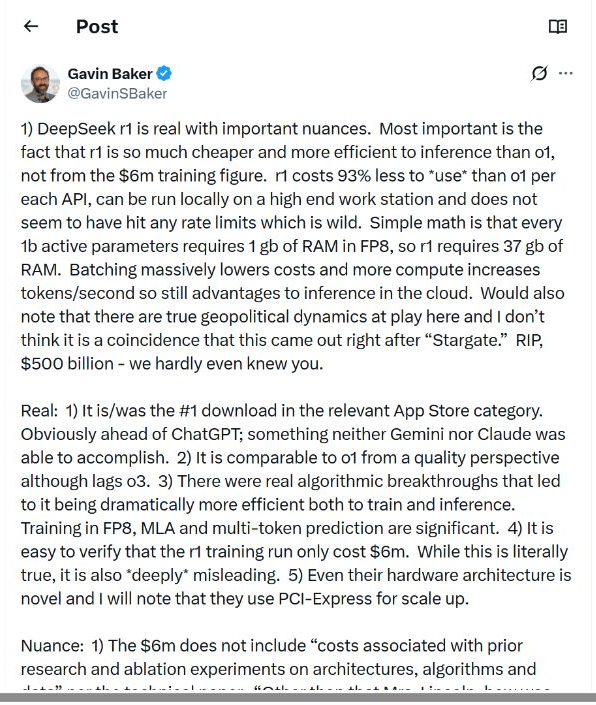
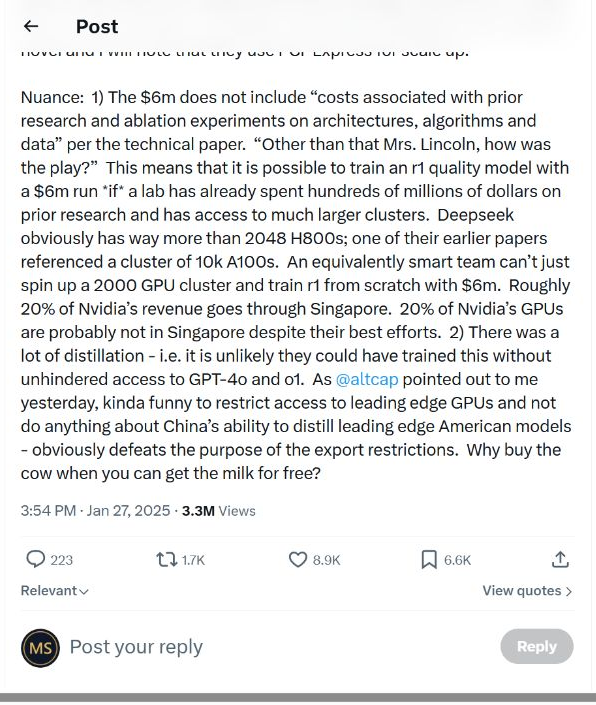
At 14:54 UTC, Gavin Baker published a detailed correction. U.S. cash trading had been open for 24 minutes.
He separated V3’s training-compute estimate from R1’s research history, infrastructure and broader model economics. His thread now shows 3.3 million views and 1.7 thousand reposts.
Corrections face a hard timing problem. The false comparison fit in one line. The scope repair needed a long thread. The fastest market move came first.
Aftermath: 133 Days Below the Previous Close
Nvidia rebounded 8.9% on Tuesday, January 28—one day after the drop. By Tuesday, February 18—22 days after the drop—it was only 2.3% below its January 24 close.
The shares fell again. They closed at $94.31 on Friday, April 4, during a wider tariff-driven market decline. Export controls, earnings, Blackwell margins and growth-stock risk joined the DeepSeek debate.
Nvidia first closed above its Friday, January 24 price on Monday, June 9—133 calendar days after the selloff. The path stayed under pressure for months. DeepSeek cannot explain every move along that path.
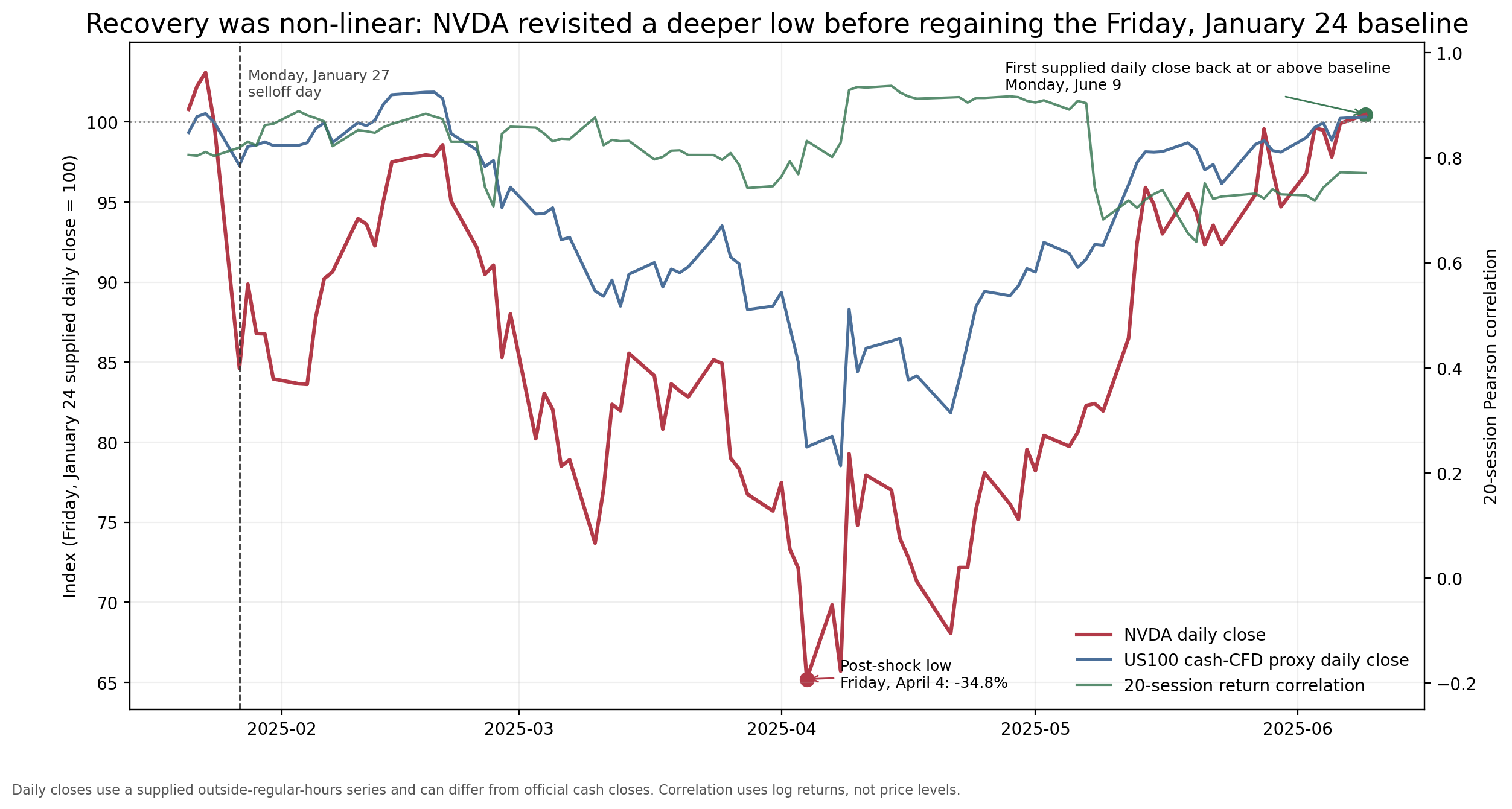
The April low occurred inside a new set of market risks. The chart keeps correlation separate from causality.
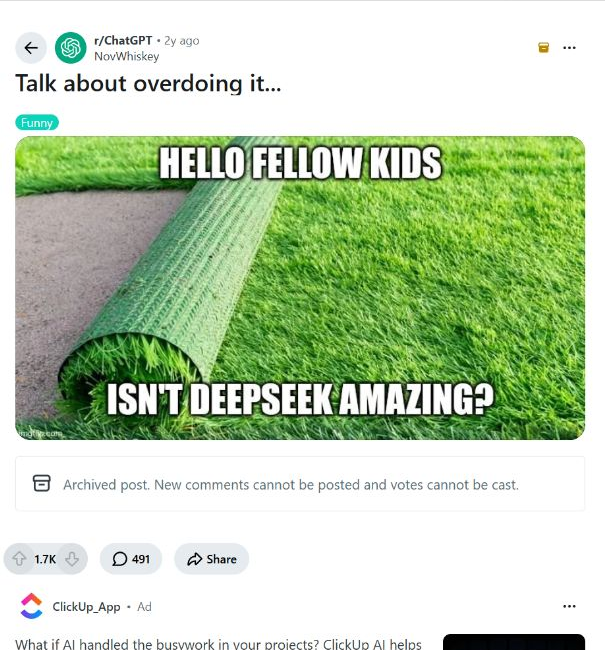
The post documents suspicion. It does not prove coordinated manipulation.
https://www.reddit.com/r/ChatGPT/comments/1iaudup/talk_about_overdoing_it/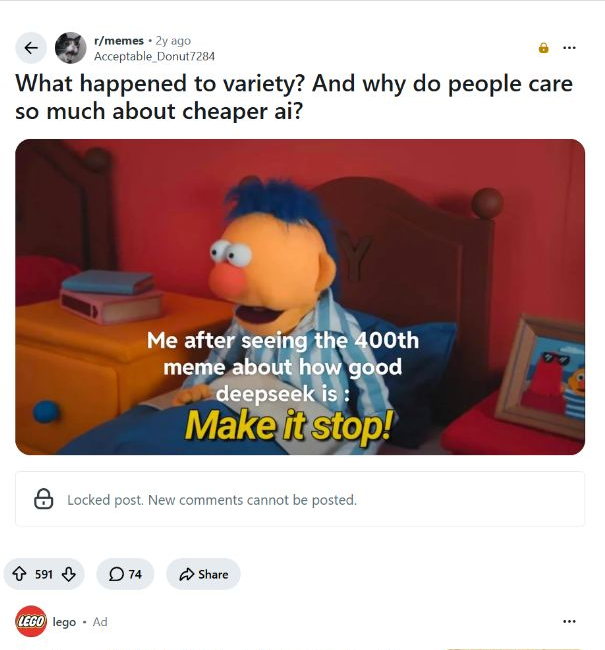
Current snapshot: 591 score and 74 comments. The raw handoff had placed this post two days too early; the corrected date is Tuesday.
https://www.reddit.com/r/memes/comments/1icbm5p/what_happened_to_variety_and_why_do_people_care/The method for the next market narrative
The Seven-Clock Narrative Framework
Narrative risk rises when several clocks speed up at once. The key measures are the rate of change, audience crossover and loss of technical detail.
A fixed copy of the paper, repository and release time preserves the source’s exact scope.
The pace of stars, forks, issues, downloads and specialist discussion matters more than the totals alone.
App rank, estimated downloads, retention and revenue each answer a different question.
A complete social record includes the post time, author, exact claim, screenshot, source URL and timestamped counter snapshot.
Independent original reports show media breadth. The key shift occurs when a technical fact becomes a valuation frame.
Price, share volume and a relevant market proxy belong on the same event timeline. A base-100 index makes relative movement clear.
Clock 7 covers correction speed. The measure is the time required for a scoped explanation to reach the audience of the simple claim.
Continue the research
The Complete Evidence Chain
The MoveSurge DeepSeek cluster separates release data, cost accounting, social amplification and the 133-day market aftermath.
Primary source index
Every screenshot carries its own direct URL. These links anchor the release, mainstream-media and market facts used in the article.
- DeepSeek-R1 repository — Monday, January 20, 2025 release artifacts.
- DeepSeek-R1 paper — technical scope and reported benchmarks.
- DeepSeek-V3 technical report — $5.576 million training-compute boundary.
- Reuters High-Flyer profile — older A100 clusters and the research base behind DeepSeek.
- Stargate announcement — a private four-year infrastructure plan, starting with $100 billion.
- Nature feature — Thursday, January 23, four days before the drop.
- The Wall Street Journal — Saturday, January 25, two days before.
- TechCrunch Sunday roundup — X posts plus App Store context.
- CNBC premarket report — Monday, January 27.
- Fortune post-close report — persistence of the false all-in R1 cost attribution.
- Associated Press market close — NVDA’s 16.9% loss and market-cap impact.
- Know Your Meme archive — contemporaneous Reddit snapshot references and corrected thread links.