Why are Treasury yields rising? The 10-year hit 5.35% on October 7, 2026, its highest since 2002
The 30-year reached 5.70% as investors sold bonds over energy-driven inflation risk, ahead of a $39 billion 10-year auction and the Fed's September minutes. Stocks opened lower.
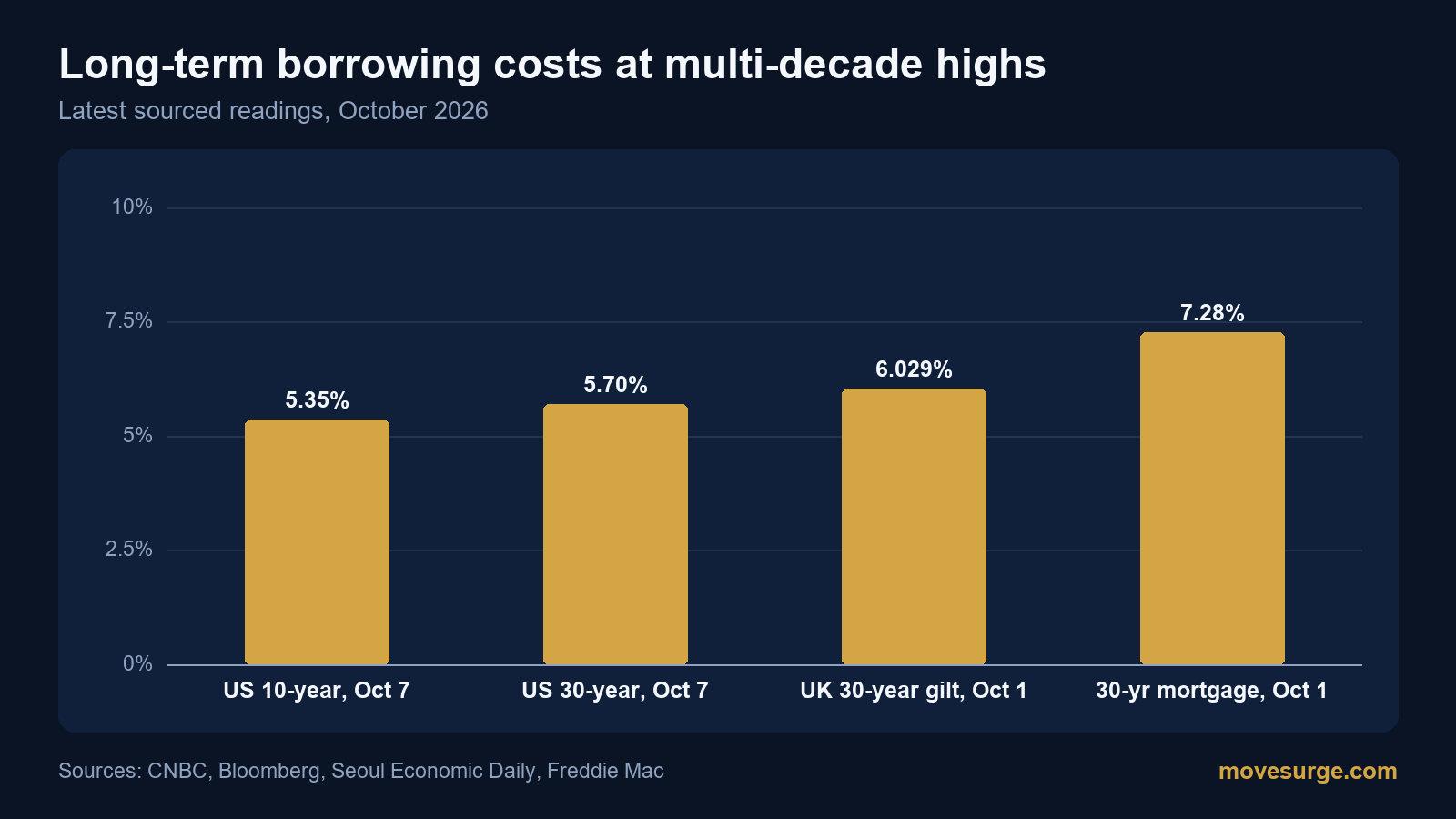
- The 10-year Treasury yield rose nearly 8 basis points to 5.35% on October 7, 2026, its highest since 2002; the 30-year reached 5.70%.
- The move came before a $39 billion 10-year note auction and the release of the Fed's September meeting minutes.
- Britain's 30-year gilt yield crossed 6% on October 1 for the first time since 1998, and Freddie Mac's 30-year mortgage average reached 7.28%.

Reaction by asset (real prices)
| Asset | 2m before | At release | +1m | +10m | +1m % | +10m % |
|---|---|---|---|---|---|---|
| USDJPY | 158.27 | 158.27 | 158.28 | 158.34 | +0.00% | +0.04% |
The 10-year US Treasury yield rose nearly 8 basis points to 5.35% on Wednesday, October 7, 2026, its highest level since 2002, and the 30-year yield climbed to 5.70%, also the highest since 2002. Bond investors were selling over inflation risk from higher energy prices, and the day carried two tests for the market: a $39 billion auction of new 10-year notes and the release of minutes from the Federal Reserve's September policy meeting. US stocks opened lower: a report that Wall Street had opened down as yields and oil rose reached the MoveSurge news feed at 09:33:28 ET, and the S&P 500 contract we track fell from 7,792.4 to 7,775.1 over the next fifteen minutes, a 0.22% drop.
Treasury, gilt and mortgage rates in October 2026
| Rate | Level | Date | Context |
|---|---|---|---|
| US 10-year Treasury yield | 5.35% | October 7, 2026 | Highest since 2002; up nearly 8 basis points on the day |
| US 30-year Treasury yield | 5.70% | October 7, 2026 | Highest since 2002 |
| UK 30-year gilt yield | 6.029% | October 1, 2026 | First move above 6% since 1998 |
| US 30-year fixed mortgage rate (Freddie Mac) | 7.28% | Week to October 1, 2026 | 7.03% a week earlier, 6.34% a year earlier; highest since November 2023 |
Why Treasury yields are rising
A bond's yield rises when its price falls, and prices have been falling because investors want more compensation to lend for ten or thirty years while energy prices keep inflation risk high. When oil climbs, the market expects inflation to stay above the Fed's target for longer, which lowers the real value of a fixed coupon and keeps the Fed from easing. The longer the maturity, the more a bond loses when inflation expectations rise, so the 30-year yield has climbed alongside the 10-year.
Supply adds to the pressure: the Treasury sells new notes and bonds every month to fund the deficit, and each auction has to clear at a yield buyers accept. Wednesday's $39 billion 10-year sale was watched for a "tail": an auction that clears above the yield the notes were trading at just before the bidding closes signals weak demand, and the higher yield then carries over into the rest of the market.
The selloff is global
Britain's 30-year gilt yield moved above 6% on October 1 for the first time since 1998, touching 6.029%. The pressure there has come from energy-driven inflation, expectations of tighter Bank of England policy, heavy gilt issuance and uncertainty ahead of the government's October 28 budget. Higher yields in one large bond market pull others up with them, because global investors compare returns across government debt; the US 10-year set its own 2002-era high of 5.34% on the same day.
How the move built over the past week
- October 1, 2026: the UK 30-year gilt yield crosses 6% for the first time since 1998, and the US 10-year reaches 5.34%, its highest since 2002. Freddie Mac's 30-year mortgage average rises to 7.28%.
- October 5, 2026: the 10-year yield sets another 2002-era high at the start of the week.
- October 6, 2026: yields ease from their highs as the surge cools.
- October 7, 2026: the 10-year rises to 5.35% and the 30-year to 5.70% before the 10-year note auction and the Fed minutes.
What higher yields mean for mortgages and stocks
Lenders price the 30-year fixed mortgage off the 10-year Treasury yield plus a spread, so the bond move passes through to home loans within days. Freddie Mac's weekly average rose to 7.28% in the week to October 1 from 7.03% a week earlier, its highest level since November 2023 and almost a full percentage point above the 6.34% of a year earlier.
For stocks, a higher risk-free yield raises the return investors demand from equities, which lowers the present value of profits expected far in the future. Growth companies, whose value rests most on distant earnings, tend to feel that first. Wednesday's open followed that pattern: the S&P 500 contract we track was 0.05% lower a minute after the 09:33:28 ET report of a weaker open and 0.22% lower fifteen minutes later.
Why were Treasury yields rising on Oct 7, 2026?
On October 7, 2026 investors were selling bonds over inflation worries tied to higher energy prices, and the Treasury was selling $39 billion of new 10-year notes the same day. Minutes from the Federal Reserve's September meeting were also due that afternoon.
What is the 10-year Treasury yield today?
The 10-year yield rose nearly 8 basis points to 5.35% on Wednesday, October 7, 2026, its highest level since 2002. The 30-year yield reached 5.70%, also the highest since 2002.
How do higher Treasury yields affect mortgage rates?
Lenders price 30-year mortgages off the 10-year yield, so mortgage rates rise with it. Freddie Mac's 30-year fixed average reached 7.28% in the week to October 1, 2026, up from 7.03% a week earlier and 6.34% a year earlier.
When was the 10-year Treasury yield last this high?
2002. The 10-year first reached a new 2002-era high of 5.34% on October 1, 2026, set another on October 5, eased on October 6 and climbed to 5.35% on October 7.
Sources
-
10-year Treasury note yield hits highest level since 2002 as traders brace for key bond sale
— CNBC
The 10-year yield rose nearly 8 basis points to 5.35%, its highest since 2002, ahead of a $39 billion 10-year note auction and the Fed's September meeting minutes; investors concerned about inflation and rising energy prices.
-
Treasury 10-Year Yield Hits Highest Since 2002 on Rate Outlook
— Bloomberg via Yahoo Finance
The 30-year Treasury yield rose to 5.70%, the highest since 2002, ahead of the release of the Fed's September meeting minutes.
-
Stock market today: Dow, S&P 500, Nasdaq fall after tech rally as bond yields, oil prices rise
— Yahoo Finance
US stocks fell on October 7, 2026 as bond yields and oil prices rose.
-
Treasury yields slide as surge to multiyear highs cools
— CNBC
Treasury yields eased on October 6 after reaching multiyear highs.
-
10-year Treasury yield rises to fresh 2002 high to start the week
— CNBC
The 10-year yield set another 2002-era high on Monday, October 5, 2026.
-
U.K. 30-Year Yield Tops 6% for First Time Since 1998
— Seoul Economic Daily
Britain's 30-year gilt yield briefly reached 6.029% on October 1, 2026, the highest since 1998, amid energy-driven inflation risk, expected tighter Bank of England policy, heavy supply and budget uncertainty.
-
Global Bond Rout: US 10-Year Yield Hits 5.34%, a 2002 High
— Vantage Markets
The US 10-year yield reached 5.34%, its highest since 2002, during the global bond selloff alongside UK gilts.
-
US Mortgage Rates Climb Further in October
— Trading Economics (Freddie Mac data)
The 30-year fixed mortgage rate averaged 7.28% in the week to October 1, 2026, up from 7.03% the prior week and 6.34% a year earlier, the highest since November 2023.
Never miss the next market-moving story
Follow the core market-moving feed across equities, macro, currencies and commodities. Your subscription includes recorded price reactions, search, watchlists, alerts and research tools.
Create free accountGo real time Watch live headlines -- free