Hurricane Isaias: a quarter of Gulf of Mexico oil output shut in as Shell and Chevron evacuate platforms, October 2026
Isaias became a hurricane late on October 7 with landfall forecast on the northern Gulf Coast late Friday or early Saturday. Regulators counted 25.08% of Gulf oil output shut in before Shell and Chevron began halting their larger hubs.
- Isaias strengthened into a hurricane with 75 mph winds late on October 7, 2026; the National Hurricane Center expects landfall on the northern Gulf Coast late Friday or early Saturday and has issued a hurricane warning from Ocean Springs, Mississippi, to the Bay/Gulf County line in Florida.
- The federal offshore regulator counted 25.08% of Gulf of Mexico oil production and 16.37% of gas production shut in on October 7, up from 9.24% of oil a day earlier.
- Shell then said it was evacuating all staff and shutting in production at Mars, Olympus, Ursa, Vito and Appomattox, and Chevron began shutting in four operated facilities.

Hurricane Isaias has shut in about a quarter of the oil produced in the US Gulf of Mexico, and the count was taken before the two largest producers began halting their main platforms. The federal offshore regulator reported on Wednesday, October 7, 2026 that 25.08% of Gulf oil output and 16.37% of gas output were shut in. That evening Shell said it was evacuating all personnel and shutting in production at its Mars, Olympus, Ursa, Vito and Appomattox hubs, a statement that reached the MoveSurge news feed at 19:48:07 ET, three minutes after Chevron said it had begun shutting in four of its operated facilities. A few hours later the National Hurricane Center upgraded Isaias to a hurricane.
Where Isaias is heading
At 10:00 p.m. CDT on October 7 the storm was about 460 miles south-southwest of the mouth of the Mississippi River, moving east-northeast at 9 mph. Half an hour later the hurricane center said reconnaissance aircraft had found 75 mph winds, making Isaias a hurricane. The forecast has it peaking at about 110 mph, Category 2 strength, before reaching the northern Gulf Coast late Friday or early Saturday, October 9 or 10, and the center said rapid intensification was a distinct possibility.
- Hurricane warning: Ocean Springs, Mississippi, to the Bay/Gulf County line in Florida.
- Tropical storm warning: from the Jefferson/Plaquemines Parish line in Louisiana to west of Ocean Springs, and east of the Bay/Gulf County line to the Aucilla River in Florida.
- Storm surge warning: from the mouth of the Mississippi River to the Steinhatchee River, Florida, with 5 to 7 feet of surge possible from Ocean Springs to Indian Pass, including Mobile Bay.
How much Gulf output is offline
The Marine Minerals Administration, which took over the work of the former Bureau of Safety and Environmental Enforcement in July, counted 8 of 371 manned platforms evacuated on October 7, together with 2 of 11 rigs that are not dynamically positioned, and 1 of 17 dynamically positioned rigs moved off location. Reuters put the oil shut-in at 511,619 barrels a day. A day earlier the count had been 185,120 barrels a day, or 9.24% of oil output and 3.36% of gas. The Gulf produced about 2.05 million barrels a day in September, roughly 15% of US crude output.
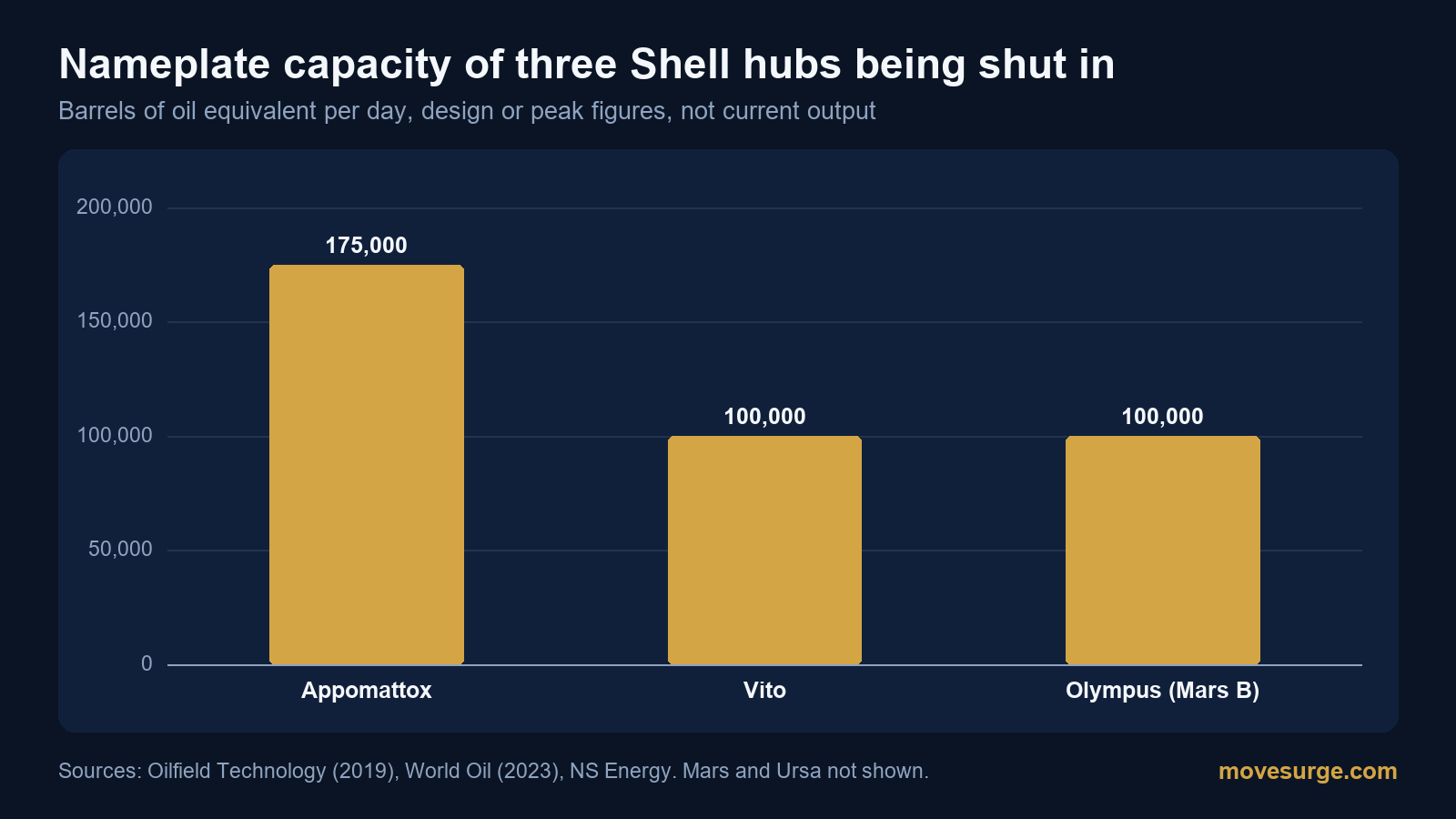
Shell's full shut-in came after the October 7 count. Three of the five hubs it named, Appomattox, Vito and Olympus, were built for a combined 375,000 barrels of oil equivalent a day at peak, and Mars and Ursa add more. Those are design figures that include gas and do not describe current output, but they indicate that the next official count is likely to be well above 25%. Chevron said four of its operated facilities were being shut in while its other five Gulf facilities kept producing normally. Neither company gave a volume. Earth Science Associates forecast mean losses over the storm of 11.17 million barrels of oil and 13.25 billion cubic feet of gas, compared with 7.12 million barrels for Tropical Storm Bertha in July.
How oil prices reacted
Early on October 7 Brent rose 1.04% to $101.63 and WTI 0.89% to $90.24, with Reuters citing both Isaias and Houthi strikes in the Middle East. By the settlement Brent had fallen 0.38% to $100.20 and WTI 1.3% to $88.28, because the International Energy Agency's faster release of emergency stocks outweighed the storm. In Asian trading on October 8, December Brent was up 2.1% at $102.34 and November WTI up 1.8% at $89.87, with Investing.com attributing the move to the Gulf disruption and to Iranian attacks on tankers near the Strait of Hormuz.
Reuters said up to six refineries could be affected, and refineries in the Gulf Coast states hold about half of the 18.2 million barrels a day of US refining capacity. No refinery had announced a shutdown by early October 8.
Timeline on the MoveSurge news feed
- October 7, 04:52 ET: the hurricane center reported that the depression had become Tropical Storm Isaias.
- October 7, 10:44 ET: Chevron said it was tracking the storm's expected path.
- October 7, 16:49 ET: the hurricane center said Isaias was rapidly intensifying.
- October 7, 19:45 ET: Chevron began shutting in production at four Gulf facilities.
- October 7, 19:48 ET: Shell said it was evacuating and halting Mars, Olympus, Ursa, Vito and Appomattox, and moving non-essential staff from Stones.
- October 8, 00:04 ET: hurricane warnings were issued for parts of the northern Gulf Coast.
How much Gulf of Mexico oil production is shut in for Hurricane Isaias?
The federal offshore regulator reported 25.08% of Gulf oil output and 16.37% of gas output shut in on October 7, 2026, about 511,619 barrels a day of oil according to Reuters. That count came before Shell and Chevron began shutting in their larger facilities.
Which Shell platforms are shut in for Hurricane Isaias?
Shell said on October 7 it was evacuating all personnel and shutting in production at Mars, Olympus, Ursa, Vito and Appomattox, and that it had moved non-essential staff from its Stones asset.
Where will Hurricane Isaias make landfall?
The National Hurricane Center expects landfall within the warning area on the northern Gulf Coast late Friday or early Saturday, October 9 or 10. A hurricane warning runs from Ocean Springs, Mississippi, to the Bay/Gulf County line in Florida.
How did oil prices react to Hurricane Isaias?
Oil settled lower on October 7, with WTI down 1.3% at $88.28, because a faster release of emergency stocks outweighed the storm. In Asian trading on October 8 WTI was up 1.8% at $89.87 as the shut-ins grew and tankers were attacked near Hormuz.
Sources
-
Hurricane Isaias Public Advisory 6 and Tropical Cyclone Update
— National Hurricane Center
Position, motion and warnings at 10:00 p.m. CDT on October 7, and landfall expected on the northern Gulf Coast late Friday or early Saturday.
-
Hurricane Isaias Forecast Discussion 6
— National Hurricane Center
Forecast peak of 95 knots (about 110 mph) and the possibility of rapid intensification.
-
MMA monitors Gulf response to Isaias
— Marine Minerals Administration
25.08% of oil and 16.37% of gas production shut in; platform and rig evacuation counts.
-
Shell, Chevron cut Gulf of Mexico output ahead of Tropical Storm Isaias
— Reuters via AOL
Shell evacuating and shutting in Mars, Olympus, Ursa, Vito and Appomattox and moving non-essential staff from Stones; Chevron shutting in four operated facilities.
-
Tropical Storm Isaias forecast to hit US Gulf Coast as hurricane early Saturday
— Reuters via Investing.com
511,619 barrels a day of oil shut in; operators with the most exposure.
-
How much Gulf production will Isaias knock out?
— Rigzone
Earth Science Associates forecast mean losses of 11.17 million barrels of oil and 13.25 bcf of gas, against 7.12 million barrels for Tropical Storm Bertha.
-
Oil prices rise as markets brace for US Gulf Coast supply disruptions
— Investing.com
December Brent up 2.1% at $102.34 and November WTI up 1.8% at $89.87, attributed to Gulf disruption and attacks on tankers near Hormuz.
-
Oil gains as US storm and Houthi air strikes threaten supply
— Reuters via The Irish Times
Early October 7 price gains; up to six refineries could be affected; Gulf states hold about half of 18.2 million barrels a day of US refining capacity.
Never miss the next market-moving story
Follow the core market-moving feed across equities, macro, currencies and commodities. Your subscription includes recorded price reactions, search, watchlists, alerts and research tools.
Create free accountGo real time Watch live headlines -- free