FAA says Boeing 737 Max software glitch is not a flight-safety issue: what the glitch is and how the stock reacted
A regulator panel ruled on October 2, 2026 that a navigation software fault on the 737 Max does not compromise flight safety. Boeing shares barely moved.
- An FAA review board found on Friday, October 2, 2026 that the 737 Max software glitch does not compromise flight safety.
- The fault can switch off vertical navigation after a missed approach when pilots change the programmed route.
- Boeing stock rose 0.18% in the first minute after the headline, a small move for a regulatory ruling.

Reaction by asset (real prices)
| Asset | 2m before | At release | +1m | +10m | +1m % | +10m % |
|---|---|---|---|---|---|---|
| BA | 194.08 | 194.08 | 194.43 | 193.75 | +0.18% | -0.17% |
On Friday, October 2, 2026, at 2:57 p.m. ET, the Federal Aviation Administration said a software glitch on Boeing's 737 Max does not compromise flight safety. Boeing stock rose 0.18% in the first minute after the headline, from a reference level of $194.08, which is a small move for a ruling on the company's most important aircraft programme.
What the Boeing 737 Max software glitch is
The fault sits in the flight management computer software. It appears in one narrow sequence. The crew flies an automated approach, abandons the landing and goes around, and then changes the route programmed into the computer. In that sequence the vertical navigation mode, known as VNAV, can disengage, and the aircraft stops following its programmed vertical path until the pilots re-select a mode or fly it manually.
Canadian carrier WestJet was reported to have first flagged the behaviour to Boeing after an entry-into-service test flight. WestJet said it had experienced no related in-service events and had procedures and training in place. Boeing told 737 operators about the condition, issued guidance that reinforced existing procedures, and said it was developing a software update.
What the FAA and Boeing said
The issue became public in late September 2026, and the FAA paused its work on certifying the 737 Max 10, the largest variant, while it analysed the fault. It then convened a Corrective Action Review Board, the panel that decides whether a reported condition needs mandatory action. The board concluded the glitch is not a safety concern because pilots retain full control of the aircraft and the indications to the flight crew are clear and unambiguous.
The effect on airlines was limited to deliveries. Southwest Airlines and United Airlines were reported to have told Boeing they would not accept new aircraft with the affected software version and would take an earlier version. No fleet was grounded and no emergency directive was issued.
How the ruling fits Boeing's 2026 record with the FAA
The finding is the latest in a run of regulator decisions that have gone Boeing's way.
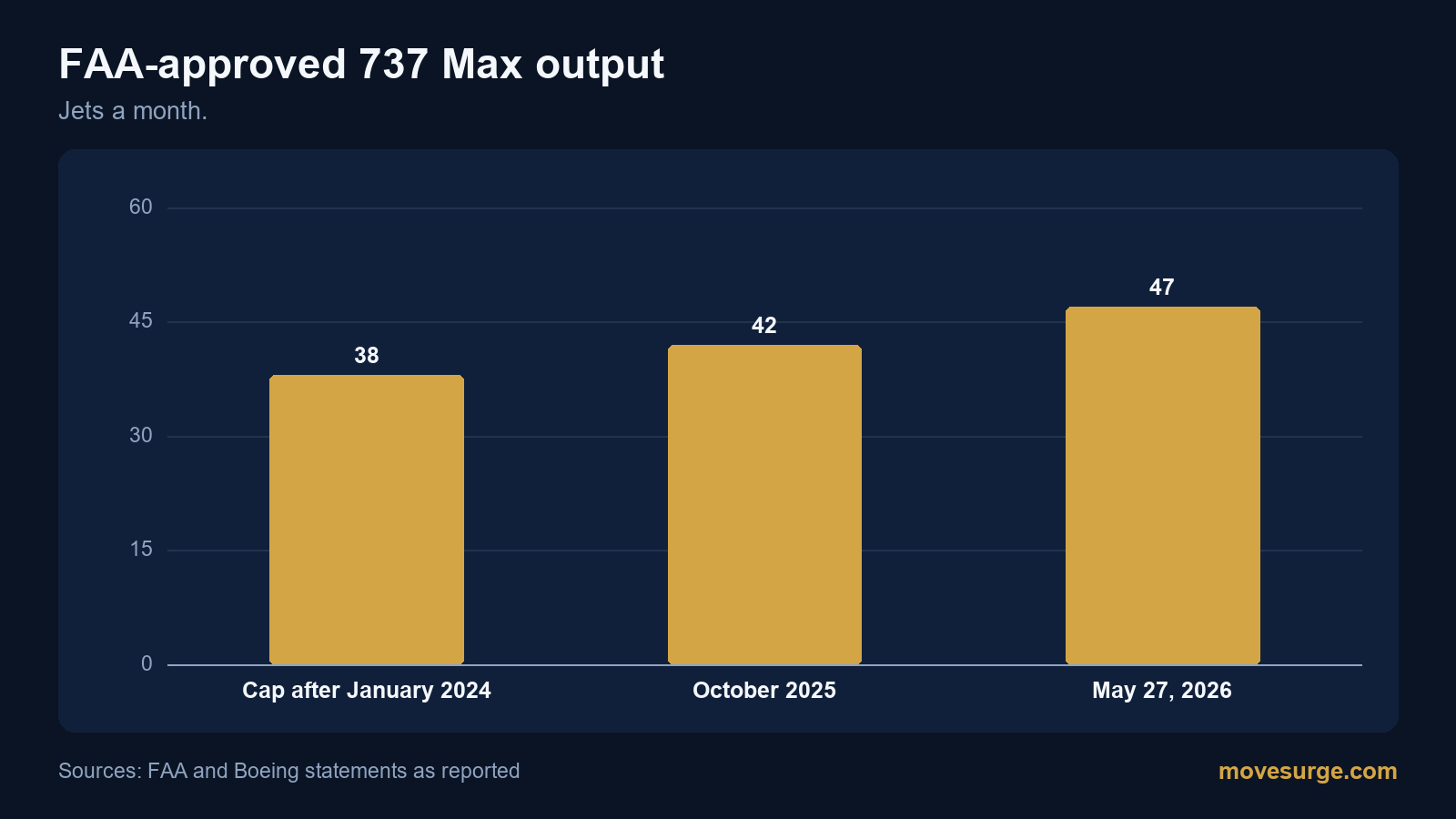
- October 2025: the FAA lifted the limit of 38 jets a month imposed on 737 Max output after the January 2024 door-plug accident, allowing 42 a month.
- May 27, 2026: Boeing completed a capstone review with the FAA and won approval to raise output to 47 a month.
- August 2026: the FAA certified the 737-7, the smallest Max, after years of delay.
- September 26, 2026: the software fault was reported publicly and Max 10 certification work was paused.
- October 2, 2026: the review board ruled the fault is not a flight-safety issue.
Each production step required the FAA to sign off on factory performance, so the regulator has been inspecting the 737 line closely for more than two years. The software question concerned the design of an avionics function rather than factory performance, and it arrived after the Max 10 had finished certification flight testing in July 2026.
Why Boeing stock barely moved
The 0.18% first-minute gain is small for news about the 737 Max, and 12 minutes after the headline the stock was 0.04% below its reference level. The fault had been public for six days, so the surprise had already passed. The FAA had announced the review board meeting in advance, which told the market a decision was due on Friday. The ruling also set no new date: the Max 10 is still uncertified, the software update is still in development, and the FAA gave no timetable for the remaining approval work.
A finding of a safety problem could have meant mandatory fixes on aircraft already flying and a longer wait for the Max 10. The board's decision left Boeing where it stood before September 26, with a software update to finish and a certification to win.
What did the FAA say about the Boeing 737 Max software glitch on October 2, 2026?
An FAA Corrective Action Review Board determined that the glitch does not compromise flight safety. The agency said pilots retain full control of the aircraft and the indications to the flight crew are clear and unambiguous.
What is the Boeing 737 Max software glitch?
It is a fault in the flight management computer software. After a missed approach, if the crew changes the programmed route, the vertical navigation mode can disengage and the aircraft stops following its programmed vertical path.
Why did Boeing stock barely move after the FAA statement on October 2, 2026?
Boeing stock rose 0.18% in the first minute after the headline, from a reference level of $194.08. The fault had been public since September 26, 2026, the review meeting had been announced in advance, and the 737 Max 10 remained uncertified after the ruling.
Did airlines ground any Boeing 737 Max aircraft over the software glitch?
No fleet was grounded. Southwest Airlines and United Airlines were reported to have declined new aircraft with the affected software version in favour of an earlier version, and WestJet said it had seen no related in-service events.
Sources
-
FAA says Boeing 737 Max software glitch not a flight-safety issue
— CNBC
FAA review board found the 737 Max software glitch is not a flight-safety issue; pilots retain full control and crew indications are clear.
-
Boeing 737 Max Software Glitch Found Not to Be Safety Concern by FAA Panel
— Bloomberg
An FAA panel determined the glitch is not a safety concern; relevance to approval of the largest Max variant.
-
US FAA set to convene review of Boeing 737 MAX software issue on Friday
— Reuters
FAA scheduled a Corrective Action Review Board for Friday; Max 10 certification paused; Southwest and United declined the affected software version. The smaller Max variant was certified in August 2026.
-
US FAA says Boeing 737 MAX software glitch poses no safety issue
— Al Arabiya
The glitch can disengage vertical navigation after a missed approach when the crew alters the programmed flight path; Boeing is developing a software update.
Never miss the next market-moving story
Follow the core market-moving feed across equities, macro, currencies and commodities. Your subscription includes recorded price reactions, search, watchlists, alerts and research tools.
Create free accountGo real time Watch live headlines -- free