Why Indonesian stocks fell to a six-year low: MSCI proposed moving Indonesia out of emerging markets
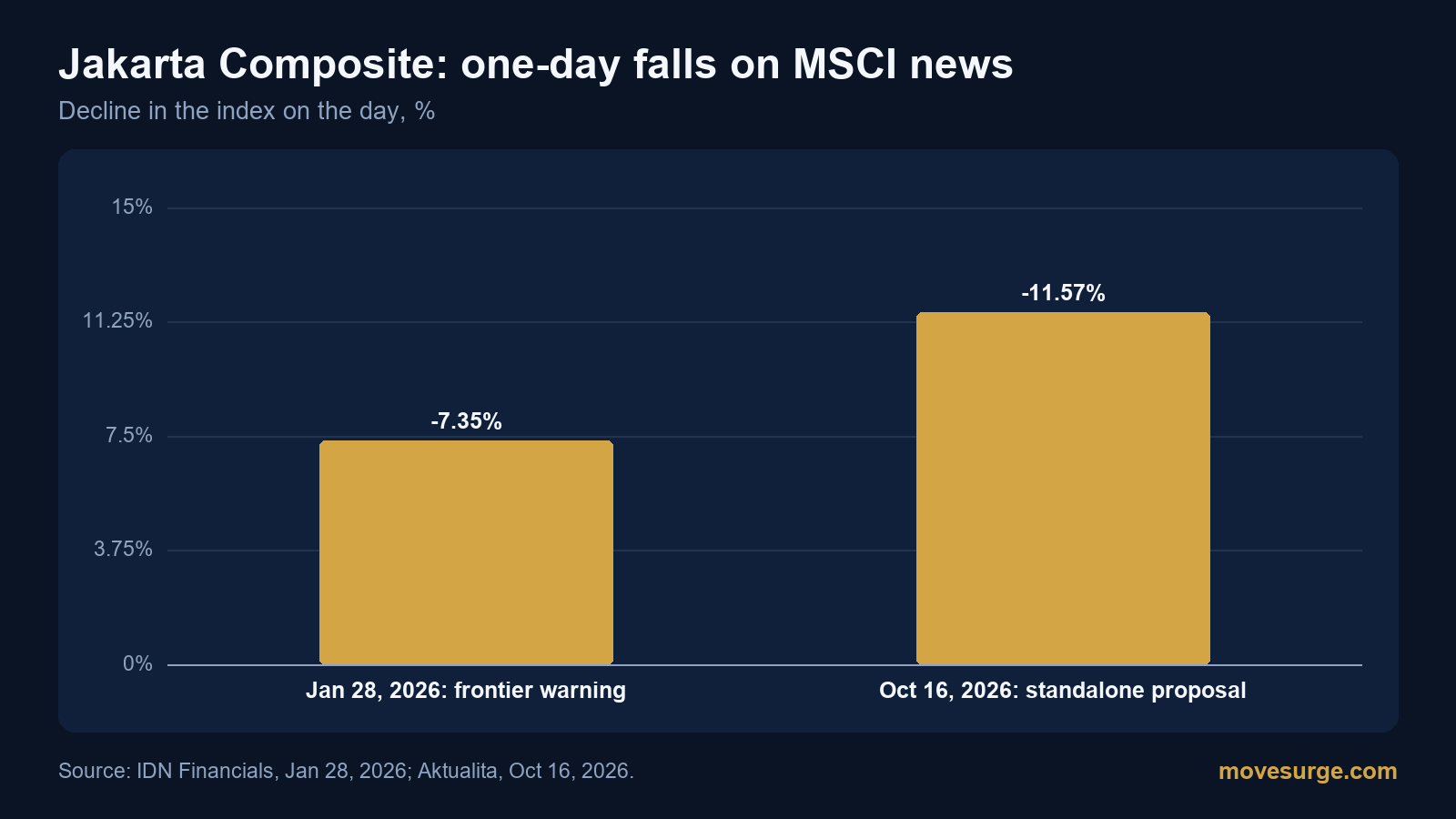
The Jakarta Composite fell 11.57% on October 16, its worst day since 1998, and more than 5% on October 19 after MSCI proposed a standalone status that index funds do not track.
- MSCI proposed on October 15, 2026 to reclassify Indonesia from Emerging Market to Standalone Market status, skipping the frontier tier.
- The Jakarta Composite fell 11.57% to 5,185.11 on October 16, its worst day since January 1998, and more than 5% on October 19 to its lowest since October 2020.
- MSCI is taking feedback until April 30, 2027 and will decide by June 30, 2027.

Indonesian stocks fell to their lowest level since October 2020 on Monday, October 19, 2026, after MSCI proposed moving Indonesia out of its emerging-market indexes to "standalone" status, outside the benchmarks that global index funds track. The Jakarta Composite Index lost more than 5% in early trading on Monday, on top of an 11.57% fall on Friday, October 16, its worst day since January 1998.
Friday's drop took the index down 678.68 points to close at 5,185.11 and set off a 30-minute trading halt. The Indonesia Stock Exchange then narrowed its lower auto-rejection limit, the largest one-day fall it allows in a single stock, to 7% from 15%, which it said would give investors time to digest the news.
What MSCI proposed
On October 15 MSCI opened a consultation on reclassifying the MSCI Indonesia Indexes from Emerging Market to Standalone Market status. It said it expects to go ahead unless the consultation finds clear evidence of material improvements in how the market is governed and functions. MSCI also said that a move to Frontier Markets, the tier below emerging markets, would not reflect the depth of the problems. Feedback is open until April 30, 2027, and MSCI will announce its decision by June 30, 2027. A freeze on some index changes for Indonesian stocks stays in place until further notice.
A standalone market sits outside MSCI's regional and global benchmarks, so funds that track the MSCI Emerging Markets index would no longer hold Indonesian shares. The surprise was the size of the step: MSCI had warned since January of a possible cut to frontier status, and standalone is lower still. MSCI's complaints center on opaque shareholding structures, suspected coordinated trading and weak enforcement. Indonesia has announced more ownership disclosure and higher minimum free-float rules, and MSCI said investors want to see them applied consistently.
The second MSCI shock this year
- January 28, 2026: MSCI flagged investability concerns, paused index additions for Indonesian stocks and warned of a possible cut to frontier status. The Jakarta Composite fell 7.35% that day, and two sessions erased about $80 billion of market value.
- June 23, 2026: MSCI kept Indonesia in emerging markets but extended its review to November.
- October 15, 2026: MSCI proposed standalone status, two steps down.
- October 16, 2026: The index fell 11.57% to 5,185.11, with a 30-minute halt.
- October 19, 2026: A fall of more than 5% in early trading took the index to its lowest since October 2020.
How much money could leave
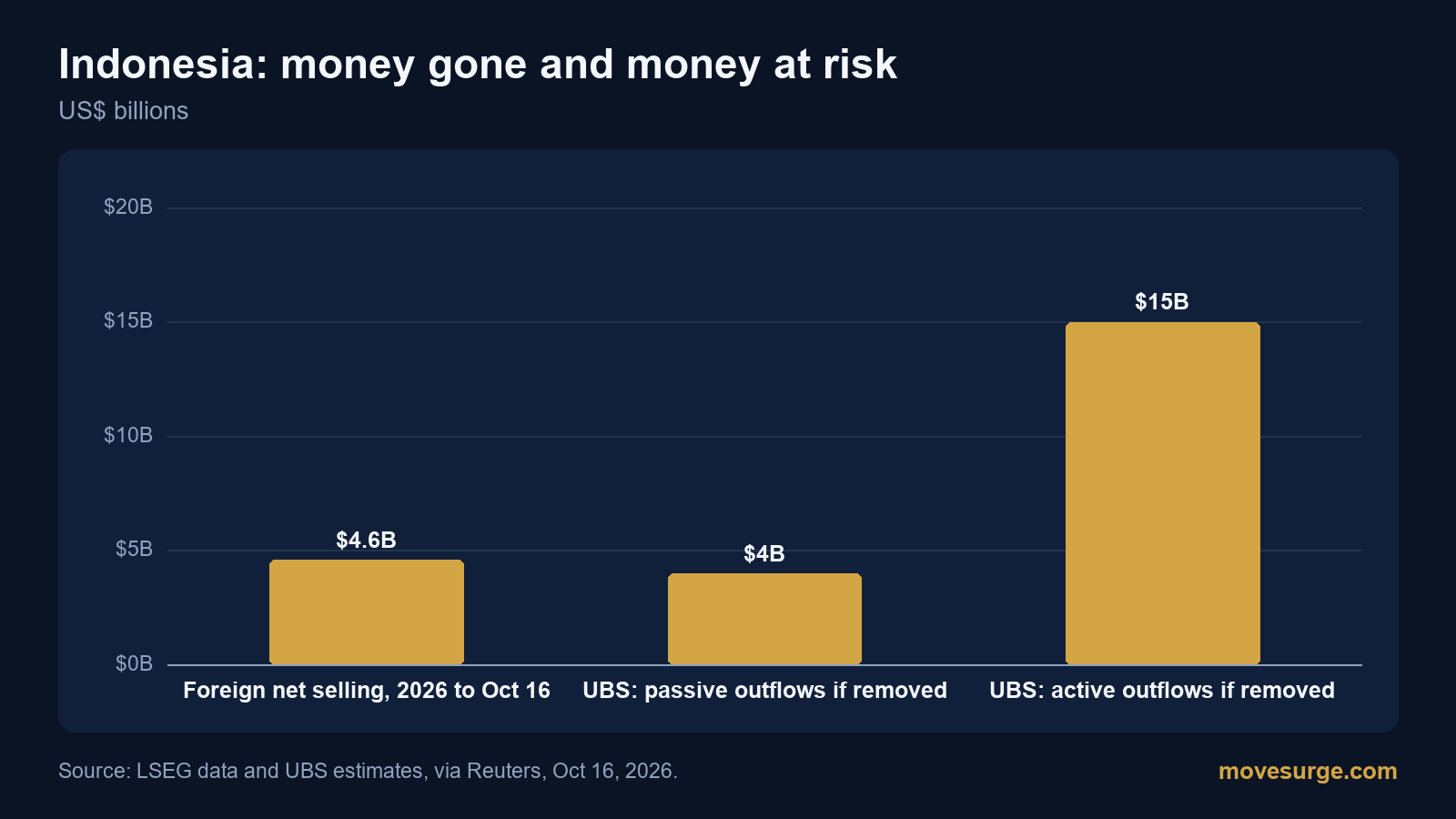
Foreign investors had already sold a net $4.6 billion of Indonesian shares this year by Friday, according to LSEG data cited by Reuters. On Friday alone they sold a net Rp 3.34 trillion, pushing net foreign selling since January to a record Rp 88.19 trillion, the Jakarta Post reported. UBS estimated that removal from global indexes could pull out another $4 billion from passive funds, which track an index automatically, and about $15 billion from active managers who use those indexes as their benchmark.
The government pushed back. Airlangga Hartarto, the coordinating minister for economic affairs, called the proposal a "big question mark" on October 16, because MSCI had not raised it when its leadership met Indonesian officials in Bangkok on October 13. He said the economy's fundamentals remain strong and that reforms must show visible progress to investors.
Why are Indonesian stocks falling?
MSCI proposed on October 15, 2026 to move Indonesia from emerging-market to standalone status, which would remove its stocks from global index funds. The Jakarta Composite fell 11.57% on October 16 and more than 5% on October 19 to its lowest since October 2020.
What does MSCI standalone status mean for Indonesia?
A standalone market is outside MSCI's emerging-market and frontier indexes, so funds that track those benchmarks would not hold Indonesian shares. UBS estimated $4 billion of passive and about $15 billion of active outflows.
When will MSCI decide on Indonesia?
MSCI is taking feedback until April 30, 2027 and will announce its decision by June 30, 2027. It said it expects to proceed unless it sees clear evidence of material improvements in market governance.
Sources
-
MSCI launches consultation on a proposal to reclassify the MSCI Indonesia Indexes
— MSCI
Consultation on moving Indonesia from Emerging Market to Standalone Market status; MSCI expects to proceed unless it sees clear evidence of material improvements; frontier status would not reflect the depth of the problems; feedback until April 30, 2027 and a decision by June 30, 2027; index-change freeze stays.
-
Indonesian stocks slide to six-year low as MSCI 'standalone' warning weighs
— The Jakarta Post
The index fell more than 5% in early trading on October 19 to its lowest since October 2020; the exchange cut the lower auto-rejection limit to 7% from 15%.
-
'Panic' blamed for record foreign outflows from stock market
— The Jakarta Post
Net foreign selling of Rp 3.34 trillion on October 16 and a record Rp 88.19 trillion since January.
-
Indonesia stocks after the MSCI standalone proposal (Reuters report, October 16, 2026)
— The Edge Malaysia (Reuters)
Worst one-day drop since January 1998; foreign investors pulled $4.6 billion this year per LSEG; UBS estimates $4 billion passive and about $15 billion active outflows.
-
JCI plummets over 11% today, Oct 16, 2026, amid MSCI panic
— Aktualita
JCI fell 11.57%, or 678.68 points, to 5,185.11 on October 16.
-
Indonesia gets a 'wake-up call' as MSCI prepares to expel it from global indexes
— U.S. News & World Report (Reuters)
MSCI's concerns about opaque shareholdings, suspected coordinated trading and weak enforcement; Indonesia's disclosure and free-float reforms; 30-minute trading halt.
-
MSCI: Indonesia stocks slump, JCI plunges 7.35%
— IDN Financials
The JCI fell 7.35% after MSCI's January 2026 warning.
-
Indonesian stocks plunge 7% after MSCI warning on investability
— Bloomberg
MSCI paused index additions for Indonesian stocks and warned of a potential frontier downgrade.
-
Indonesian stocks shed US$80 billion on MSCI warning
— Malay Mail
About $80 billion of market value was erased in two sessions after the January warning.
-
Status Pasar Saham RI Terancam Turun, Airlangga Pertanyakan Sikap MSCI
— IDX Channel
Airlangga Hartarto called the proposal a big question mark on October 16 because it was not raised at the October 13 Bangkok meeting with MSCI leadership; fundamentals strong; reforms must show visible progress.
-
MSCI delays Indonesia's market status review until November
— Fortune
MSCI kept Indonesia's emerging-market status and extended its review to November 2026.
Never miss the next market-moving story
Follow the core market-moving feed across equities, macro, currencies and commodities. Your subscription includes price moves after the news, search, watchlists, alerts and research tools.
Create free accountGo real time Watch live headlines -- free