Why Roivant Stock Rose: Brepocitinib Met Its Goal in Both Phase 3 Uveitis Trials
Roivant and Priovant said brepocitinib met the main goal of both CLARITY Phase 3 trials in non-infectious uveitis, with median time to treatment failure above 48 weeks against about 12 on placebo. ROIV rose 5.39% in a minute.
- Roivant stock rose 5.39% in the minute after the CLARITY results crossed at 07:00:01 ET on October 21, 2026, to $36.57 from $34.70 in thin premarket trading.
- Median time to treatment failure was more than 48 weeks on brepocitinib 45 mg against about 12 weeks on placebo in both trials.
- Across both trials, 62% of patients reached steroid-free quiescence at week 48, against 20% on placebo.

Reaction by asset (real prices)
| Asset | 2m before | At release | +1m | +10m | +1m % | +10m % |
|---|---|---|---|---|---|---|
| ROIV | 34.70 | 34.70 | 36.57 | 36.60 | +5.39% | +5.48% |
Roivant Sciences stock rose 5.39% in the first minute after Roivant and its subsidiary Priovant reported that brepocitinib met its main goal in two Phase 3 trials in non-infectious uveitis. The results reached the MoveSurge news feed at 07:00:01 ET on Wednesday, October 21, 2026, and the shares went from $34.70 to $36.57 in thin premarket trading. Patients on the once-daily pill went a median of more than 48 weeks before treatment failure, the trials' main measure, against about 12 weeks on placebo.
Non-infectious uveitis is inflammation inside the eye that an infection did not cause. It can damage sight, and doctors usually control it with steroids, which cause side effects when patients take them for a long time. Treatment failure in these trials counts signs that the inflammation has come back or that vision has worsened. Both trials, CLARITY-1 and CLARITY-2, tested a 45 mg daily dose and met every key secondary goal as well as the main one, according to the companies.
| Week 48 | Brepocitinib 45 mg | Placebo |
|---|---|---|
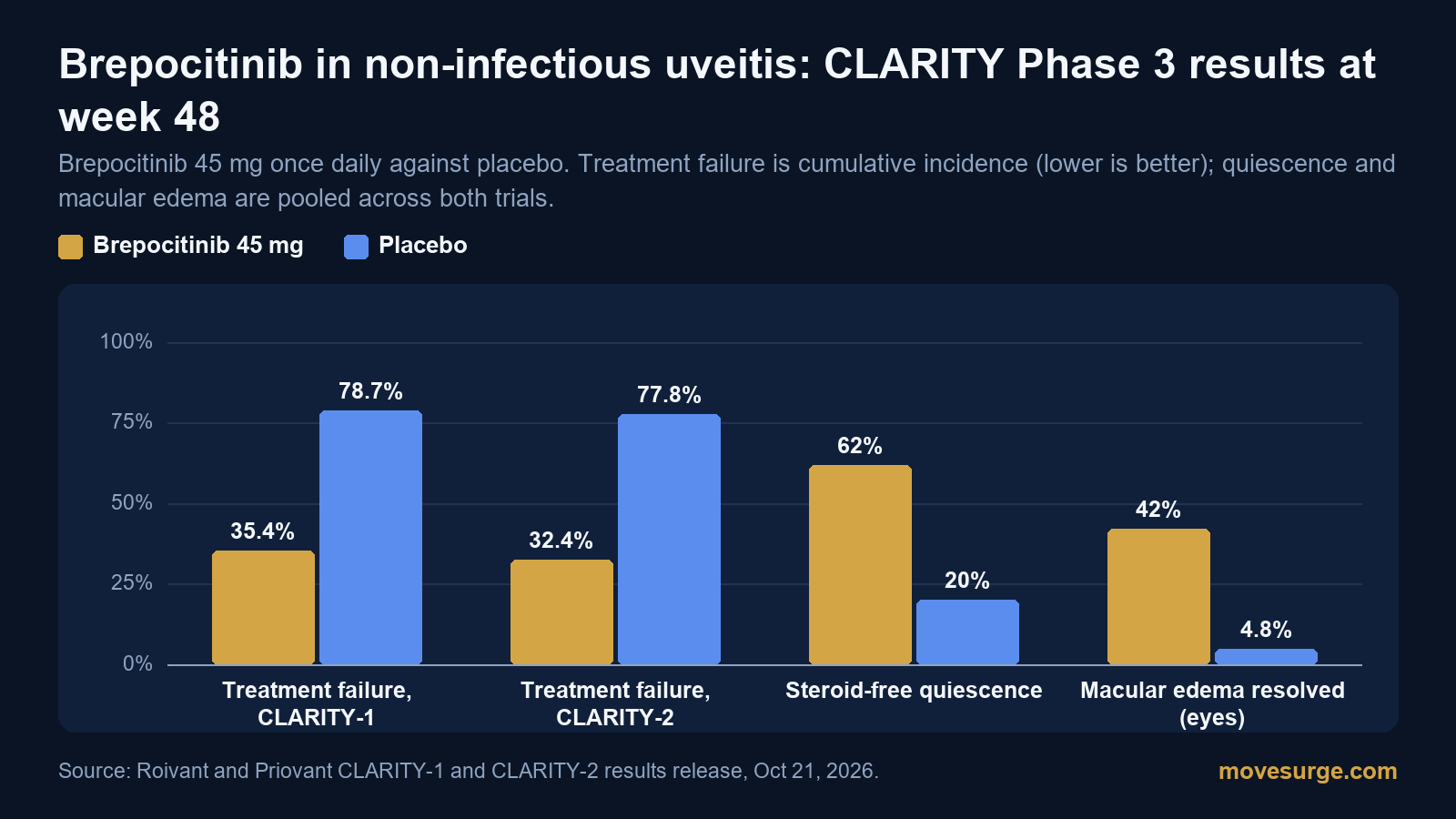
| Treatment failure, CLARITY-1 | 35.4% | 78.7% |
| Treatment failure, CLARITY-2 | 32.4% | 77.8% |
| Median time to treatment failure | More than 48 weeks | About 12 weeks |
| Steroid-free quiescence, both trials | 62% | 20% |
| Macular edema resolved, eyes, both trials | 42% | 4.8% |
What the secondary results add
Steroid-free quiescence means the inflammation was inactive while the patient took no steroids. Across both trials, 62% of patients on brepocitinib reached it at week 48, against 20% on placebo. Macular edema, swelling at the center of the retina, is a common cause of vision loss in uveitis. Among patients who started the trials with it, the swelling cleared in 42% of eyes on brepocitinib and in 4.8% of eyes on placebo. About 3% of participants stopped treatment because of a side effect, and the companies reported no new safety signals.
A second use for a drug that is already approved
Brepocitinib is already on sale in the United States. The FDA approved it on August 27, 2026, as Lisraya, a 30 mg tablet for adults with dermatomyositis, a rare disease that inflames muscles and skin. It was the first oral drug approved for that disease. Because the drug is approved, Priovant will ask to add uveitis through a supplemental new drug application, the filing used to add a new use to an approved medicine, and it plans to submit it in the first half of 2027. The uveitis trials used a higher dose than the approved tablet, 45 mg against 30 mg.
How the stock traded
ROIV was at $34.70 just before the release and at $36.60 ten minutes later, up 5.48%, with very few shares trading before the open. At 10:08 ET it was at $37.26, up 6.70% on the day, according to Yahoo Finance. On August 31, four days after the dermatomyositis approval, the stock was at $34.12, close to where it stood before Wednesday's release.
Why is Roivant stock up today?
Roivant and Priovant reported on October 21, 2026, that brepocitinib met the main goal of both CLARITY Phase 3 trials in non-infectious uveitis. The stock rose 5.39% in the first minute of premarket trading, to $36.57 from $34.70.
What did the brepocitinib uveitis trials show?
Patients on brepocitinib 45 mg went a median of more than 48 weeks before treatment failure, against about 12 weeks on placebo. Across both trials, 62% of patients on brepocitinib had inactive inflammation without steroids at week 48, against 20% on placebo.
When could brepocitinib be approved for uveitis?
Priovant plans to submit a supplemental new drug application to the FDA in the first half of 2027. Brepocitinib is already approved in the United States as Lisraya for adults with dermatomyositis.
Sources
-
Roivant and Priovant Announce Positive Results in CLARITY-1 and CLARITY-2 Phase 3 Trials for Brepocitinib in Non-Infectious Uveitis (NIU)
— Roivant Sciences via GlobeNewswire
Both trials met the primary and key secondary endpoints; median time to treatment failure above 48 weeks against about 12 weeks; pooled steroid-free quiescence 62% against 20%; macular edema resolution 42% against 4.8%; 3% discontinuation; sNDA planned for the first half of 2027.
-
Roivant's brepocitinib meets primary endpoint in uveitis trials
— Investing.com
Cumulative incidence of treatment failure at week 48: 35.4% against 78.7% in CLARITY-1 and 32.4% against 77.8% in CLARITY-2.
-
Roivant Sciences Says Brepocitinib Meets Primary Goal In Uveitis Trials; Shares Rise
— RTTNews
Independent report that brepocitinib met the primary goal in both uveitis trials and that the shares rose.
-
Roivant and Priovant announce positive results in CLARITY-1 and CLARITY-2
— StockTitan
Median time to treatment failure above 48 weeks; supplemental new drug application timing.
Never miss the next market-moving story
Follow the core market-moving feed across equities, macro, currencies and commodities. Your subscription includes price moves after the news, search, watchlists, alerts and research tools.
Create free accountGo real time Watch live headlines -- free