China's central bank plans to make the overnight reverse repo rate its main policy rate: what Pan Gongsheng said on October 19, 2026
Governor Pan Gongsheng said the overnight rate will replace the 1.4% seven-day rate as China's main policy rate once operations switch, and announced a backstop for bond-fund redemptions.
- PBOC Governor Pan Gongsheng said on October 19, 2026 the bank will study moving its main operations to overnight, making the overnight reverse repo rate the main policy rate.
- The seven-day reverse repo rate has been the main benchmark since 2024 and has stayed at 1.4% since May 2025; no date was given for the switch.
- Pan announced a liquidity tool for asset managers facing large redemptions, set up with the banking and securities regulators, plus a wider Standing Lending Facility.

China's central bank will study moving its main market operations to an overnight term "at an appropriate time," and the overnight reverse repo rate would then become its main policy rate, Governor Pan Gongsheng said on Monday, October 19, 2026, at the Financial Street Forum in Beijing. The overnight rate would replace the seven-day reverse repo rate, which has been the main policy benchmark since 2024 and has stayed at 1.4% since May 2025.
Pan gave no date for the switch. In the same speech he announced a liquidity tool for fund managers and other non-bank institutions hit by large redemptions, and a wider list of institutions that can borrow from the central bank's Standing Lending Facility. China's 30-year government bond yield fell more than 1 basis point after the remarks, Reuters reported. A basis point is 0.01 percentage point.
What the switch would change
A reverse repo is the central bank lending cash to banks for a fixed period, with bonds as collateral. The People's Bank of China (PBOC) now signals its stance through the rate on seven-day loans. Pan said the overnight interbank repo rate has in effect already become the rate the PBOC steers, so the change would make the official policy rate match the one it manages day to day. We explained that earlier shift, when the overnight rate became the PBOC's working target, in our August 2026 article.
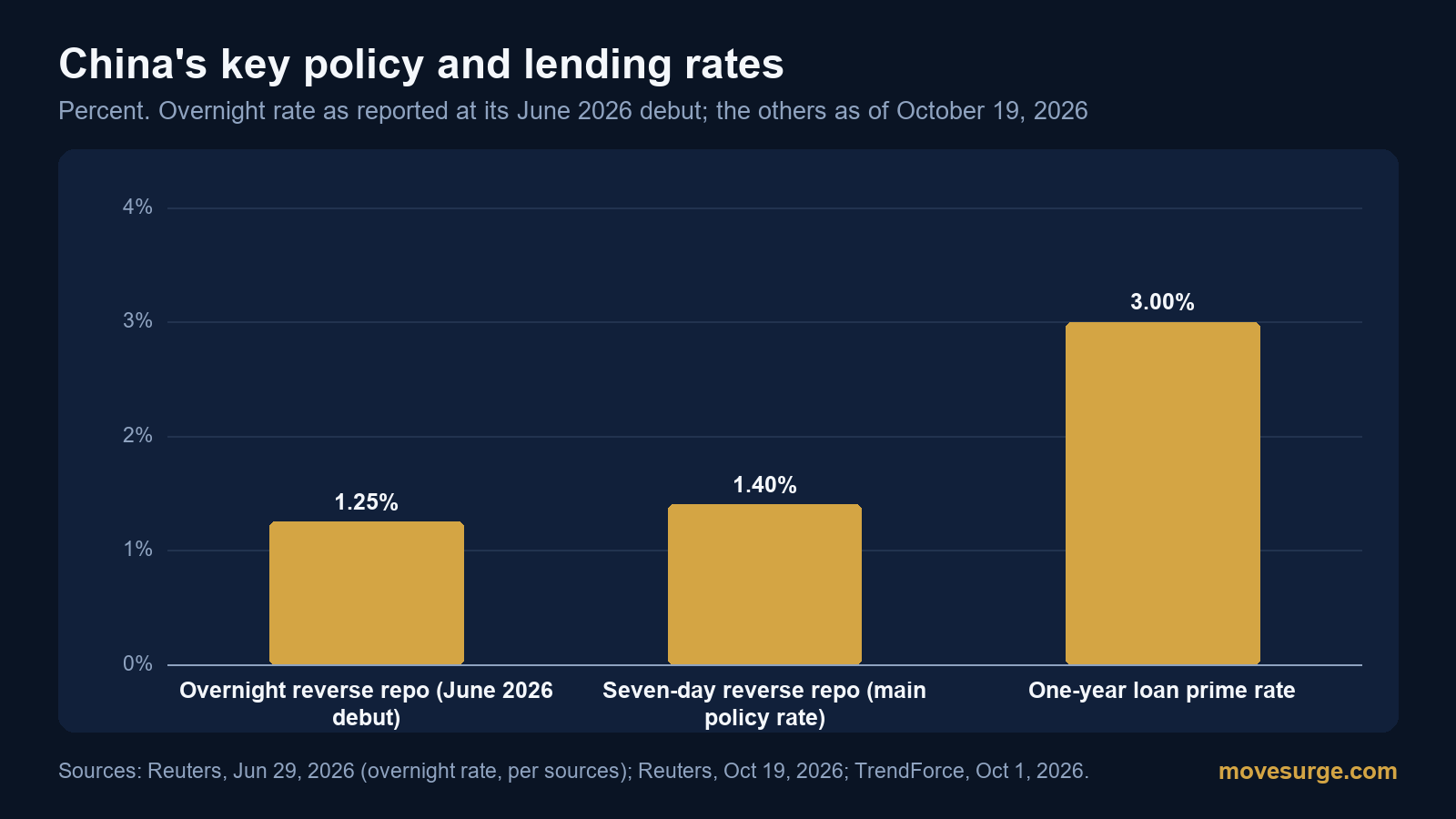
The two short rates are close. When the PBOC ran its first overnight reverse repo in June, it did not publish the rate, and sources told Reuters it was 1.25%, below the seven-day rate. The one-year loan prime rate, the benchmark banks use to price most loans, is 3.0%. Reuters expects the October fixing on Tuesday, October 20, to leave the loan prime rates unchanged for a 17th month.
How China's policy rate got here
- 2024: the seven-day reverse repo rate became the PBOC's main policy rate.
- May 2025: the seven-day rate was cut to 1.4%, where it has stayed.
- June 2026: the PBOC began overnight reverse repo operations, at a rate of 1.25% according to sources cited by Reuters.
- October 19, 2026: Pan said the overnight reverse repo rate will become the main policy rate once main operations move to overnight.
A backstop for bond-fund runs
The second measure targets a problem China's bond market has had before. When many investors pull money from bond funds and wealth-management products at the same time, managers have to sell bonds, prices fall, and more investors redeem. Pan said the PBOC will set up a liquidity tool with the National Financial Regulatory Administration and the China Securities Regulatory Commission for that situation.
The tool would be used only when asset managers face a shared liquidity squeeze or the bond market falls into a cycle of redemptions and forced sales, Chinese financial media reported. Borrowers must meet macroprudential rules and post high-grade collateral, which the PBOC said is meant to avoid distorting prices or creating the belief that it will always step in. Bank wealth-management units, mutual fund managers and their parent banks and brokerages would be eligible. Caixin reported in June that the idea followed earlier stress, including the late-2022 redemption wave in wealth-management products and a bond-fund selloff in the third quarter of 2025.
Pan also said the PBOC will run pilots that make it easier for overseas financial institutions to buy and sell yuan in the onshore foreign exchange market.
What is China's main policy rate?
The seven-day reverse repo rate, at 1.4% since May 2025. On October 19, 2026 PBOC Governor Pan Gongsheng said the overnight reverse repo rate will become the main policy rate after the central bank moves its main operations to overnight.
When will the PBOC switch to an overnight policy rate?
Pan gave no date. He said the PBOC will study the switch and make it at an appropriate time.
What is the PBOC's liquidity tool for non-bank redemptions?
It is a backstop for asset managers facing large redemptions, set up with China's banking and securities regulators. It would be used only in a market-wide squeeze, and borrowers must post high-grade collateral.
Sources
-
China's central bank studies making overnight rate its main policy rate
— Reuters (via Investing.com)
Pan said the PBOC will study switching to the overnight reverse repo rate as its main policy rate, replacing the seven-day rate that has been the main benchmark since 2024 at 1.4%; the overnight interbank repo rate has effectively become the target rate; liquidity tool for non-banks and wider Standing Lending Facility; 30-year yield fell more than 1 basis point.
-
China Signals Overnight Rate Set to Become Main Policy Benchmark
— Bloomberg
The PBOC will study switching the main open-market operation tenor to overnight at an appropriate time, after which the overnight reverse repo rate becomes the main policy rate.
-
中国人民银行宣布将出台多项政策举措
— The Paper
Measures announced at the 2026 Financial Street Forum: a liquidity tool for large redemptions at non-bank institutions, a wider Standing Lending Facility and pilots for overseas institutions in the onshore FX market.
-
扩大常备借贷便利的适用机构范围等 央行公布系列措施
— 21st Century Business Herald
The redemption tool is set up with the NFRA and CSRC, used only when asset managers face group liquidity risk or a redemption and sell-off spiral, requires macroprudential compliance and high-grade collateral, and covers bank wealth-management subsidiaries, fund managers and their parent banks and securities firms.
-
China set to leave benchmark lending rates unchanged for 17th month
— Reuters (via U.S. News & World Report)
The October loan prime rate fixing is expected to leave rates unchanged for a 17th month.
-
China's one-year LPR kept unchanged for 16 consecutive months, steady at a record low of 3.0%
— TrendForce
One-year LPR at 3.0%; the seven-day reverse repo rate has stayed at 1.40% since its last cut.
-
China debuts overnight reverse repos at 1.25%, sources say
— Reuters (via Yahoo Finance)
The PBOC's first overnight reverse repo was priced at 1.25%, below the seven-day rate, according to sources; the PBOC did not announce the rate.
-
PBOC Explores Contingent Liquidity Backstop for Nonbanks
— Caixin Global
The backstop idea followed earlier stress, including the late-2022 wealth-management redemption wave and the Q3 2025 bond-fund selloff.
Never miss the next market-moving story
Follow the core market-moving feed across equities, macro, currencies and commodities. Your subscription includes price moves after the news, search, watchlists, alerts and research tools.
Create free accountGo real time Watch live headlines -- free