Why Capital One Stock Rose After Q3 2026 Earnings: Card Losses Fell and Reserves Were Released
Capital One beat third-quarter estimates on October 20, 2026 with adjusted EPS of $6.69 against $5.50 expected, as card charge-offs fell and it released reserves. The stock rose 2.19% in the first minute.
- Capital One earned $6.69 a share on an adjusted basis in the third quarter, against $5.50 expected, on revenue of $16.34 billion.
- The domestic card net charge-off rate fell to 3.98% from 4.71% in the second quarter, and the bank released $225 million of reserves.
- Adjusted EPS excludes $868 million of pre-tax items, including $338 million of Discover integration costs.

Reaction by asset (real prices)
| Asset | 2m before | At release | +1m | +10m | +1m % | +10m % |
|---|---|---|---|---|---|---|
| COF | 205.60 | 205.60 | 210.11 | 211.00 | +2.19% | +2.63% |
Capital One stock rose 2.19% within a minute of its third-quarter results reaching the MoveSurge news feed at 16:06:13 ET on Tuesday, October 20, 2026, climbing to $210.11 from $205.60. Adjusted earnings per share (EPS) were $6.69, well above the $5.50 analysts expected, while revenue of $16.34 billion was close to the $16.27 billion consensus.
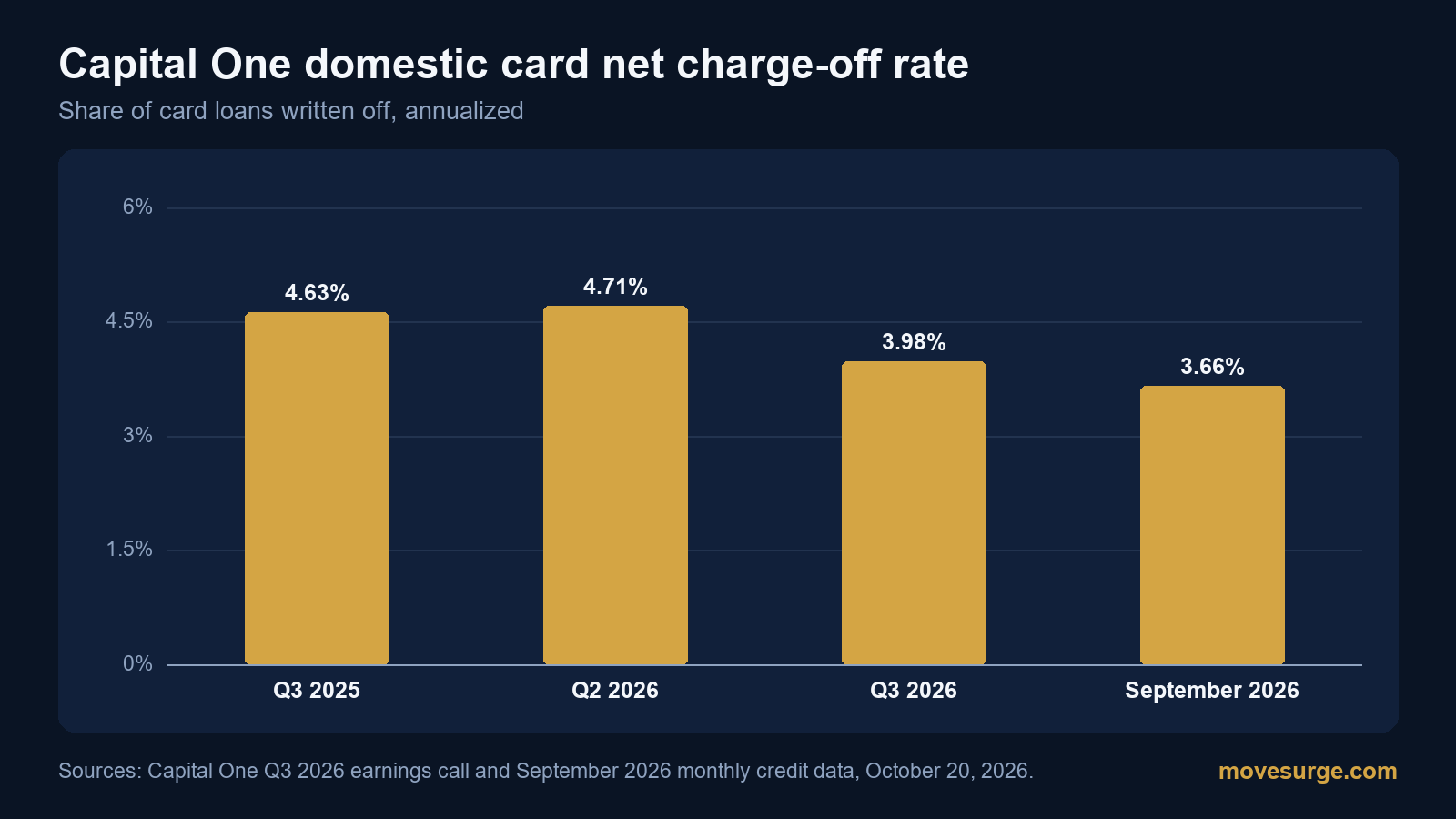
The beat came from credit rather than sales. Capital One set aside less money for future loan losses because fewer card customers defaulted, and it released $225 million of reserves it had built earlier. Its domestic card net charge-off rate, the share of card loans written off as uncollectable, fell to 3.98% from 4.71% in the second quarter.
| Third quarter | 2026 | 2025 |
|---|---|---|
| Total net revenue | $16.34 billion | $15.36 billion |
| Net income | $3.5 billion | $3.19 billion |
| EPS | $5.61 | $4.83 |
| Adjusted EPS | $6.69 | $5.95 |
| Provision for credit losses | $2.9 billion | $2.71 billion |
| Domestic card net charge-off rate | 3.98% | 4.63% |
| Net interest margin | 8.41% | 8.36% |
| Common equity tier 1 ratio | 13.8% | 14.4% |
Why credit drove the beat
The provision for credit losses was $2.9 billion, smaller than the $3.1 billion of loans Capital One actually wrote off in the quarter, because the bank released reserves. Monthly data filed the same day showed the card charge-off rate at 3.66% in September, on $787 million of charge-offs, below the quarterly average. Card loans 30 or more days past due rose to 3.74% from 3.39% in the second quarter, which Capital One described as a normal seasonal rise. That rate was 0.15 percentage point lower than a year earlier.
Net interest margin, the gap between what the bank earns on loans and pays on deposits as a share of assets, widened to 8.41% from 8.01% in the second quarter.
Discover integration costs and savings
Adjusted EPS excludes $868 million of pre-tax items: $483 million of amortization tied to acquisitions, $338 million of Discover integration costs and $47 million of costs to integrate Brex. On the call, Capital One said it is running at about $1.8 billion of annual Discover savings, against a target of $2.7 billion by 2027. About 25 million debit cards now run on the Discover network. Moving Capital One credit cards onto it is still in testing, and the existing Discover card portfolio is due to convert in the first quarter of 2027. Management also said marketing spending will rise again in the fourth quarter.
How the stock traded
Capital One closed the regular session at $201.56, according to Investing.com, and was already trading higher after hours when our headline arrived. From the $205.60 level just before the headline, it reached $210.11 a minute later, up 2.19%, and $211.00 after ten minutes, up 2.63%. The chart's last candle, 15 minutes after the headline, closed at $210.00, up 2.14%. Investing.com later reported the stock up 3.89% at $209.41 from the close.
Why did Capital One stock rise after Q3 2026 earnings?
Capital One reported adjusted EPS of $6.69 on October 20, 2026, against $5.50 expected, mainly because card charge-offs fell and it released $225 million of loan-loss reserves. The stock rose 2.19% in the first minute after the results reached our news feed.
What was Capital One's card charge-off rate in Q3 2026?
The domestic card net charge-off rate was 3.98%, down from 4.71% in the second quarter and 4.63% a year earlier. In September alone it was 3.66%.
How is the Discover integration going?
Capital One said it is running at about $1.8 billion of annual savings from the Discover deal, against a $2.7 billion target by 2027. Debit cards have moved to the Discover network; credit cards are still in testing.
Sources
-
Capital One reports third quarter 2026 net income of $3.5 billion (Form 8-K, Exhibit 99.1)
— Capital One via SEC EDGAR
Net income, EPS, adjusted EPS, revenue, provision, reserve release, net charge-offs, net interest margin, CET1 and adjusting items.
-
Capital One reports third quarter 2026 net income of $3.5 billion
— Capital One
Third-quarter 2026 results release.
-
Capital One monthly credit metrics, September 2026 (Form 8-K, Exhibit 99.1)
— Capital One via SEC EDGAR
September domestic card net charge-offs of $787 million, a 3.66% rate.
-
Capital One's strong quarter and progressing Discover integration are rewarded
— CNBC
Revenue of $16.34 billion against $16.27 billion consensus; adjusted EPS of $6.69 against $5.50.
-
Earnings call transcript: Capital One beats Q3 2026 estimates, shares rise
— Investing.com
Regular-session close of $201.56; after-hours gain of 3.89% to $209.41.
-
Capital One stock climbs as lower credit loss provision, expenses drive Q3 earnings beat
— Seeking Alpha
The beat was driven by lower credit-loss provisions and expenses.
-
Capital One (COF) Q3 2026 earnings call transcript
— The Motley Fool
Card charge-off and delinquency rates, Discover synergies, debit network migration and marketing plans.
Never miss the next market-moving story
Follow the core market-moving feed across equities, macro, currencies and commodities. Your subscription includes price moves after the news, search, watchlists, alerts and research tools.
Create free accountGo real time Watch live headlines -- free